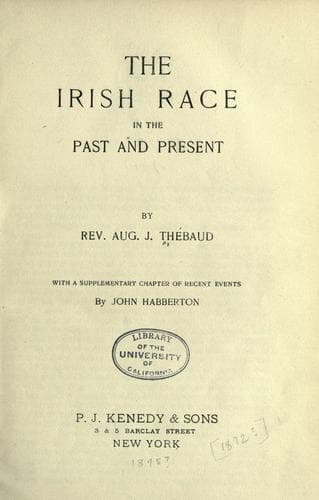
The Irish Race in the Past and the PresentThébaud, Augustus J.
History
The Irish Race in the Past and the Present
Thébaud, Augustus J.
Ireland -- History
Still less could they understand the freedom and familiarity
existing between the Irish nobility and the poorest of their
kinsmen, so different from the haughty bearing of an aristocracy
of foreign extraction to the serfs and villeins of a people they
had conquered.
The two nations now confronting each other had, therefore,
nothing in common, unless, perhaps, an excessive pertinacity of
purpose. The new comers belonged to a stern, unyielding,
systematic stock, which was destined to give to Europe that
great character so superior in our times to that of southern or
eastern nations. The natives possessed that strong attachment to
their time-honored customs, so peculiar to patriarchal tribes,
in whose nature traditions and social habits are so strongly
intermingled, that they are ineradicable save by the utter
extirpation of the people.
And now the characteristics of both races were to be brought out
in strong contrast by the great question of property in the soil,
which was at the bottom of the struggle between clanship and
feudalism. The Irish, as we have seen, knew nothing of
individual property in land, nor of tenure, nor of rent, much
less of forfeiture. They were often called upon by their
chieftains to contribute to their support in ways not seldom
oppressive enough, but the contributions were always in kind.
A new and very different system was to be attempted, to which
the Irish at first appeared to consent, because they did not
understand it, attaching, as they did, their own ideas to words,
which, in the mouths of the invaders, had a very different
meaning.
With the Irish "to do homage" meant to acknowledge the
superiority of another, either on account of his lawful
authority or his success in war; and the consequences of this
act were, either the fulfilment of the enactments contained in
the "Book of Rights," or submission to temporary conditions
guaranteed by hostages. But that the person doing homage became
by that act the liegeman of the suzerain for life and
hereditarily in his posterity, subject to be deprived of all
privileges of citizenship, as well as to the possibility of
seeing all his lands forfeited, besides many minor penalties
enjoined by the feudal code which often resolved itself into
mere might--such a meaning of the word homage could by no
possibility enter the mind of an Irishman at that period.
Public-domain text, read in full here on John Shaqi.
Reviews
Reviews
No reviews yet
Be the first to share your thoughts on this work.
Elsewhere in the archive
Join the Discussion
Join the discussion
Sign in to leave a comment or review.
Sign InorCreate an account