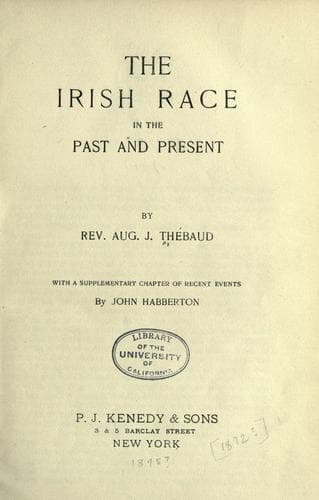
The Irish Race in the Past and the PresentThébaud, Augustus J.
History
The Irish Race in the Past and the Present
Thébaud, Augustus J.
Ireland -- History
Hence, when, after the atrocities committed by the first
invaders, who respected neither treaties nor the dictates of
humanity, not even the sanctuary and the sacredness of religious
houses, Henry II. came with an army, large and powerful for that
time, the Irish people and their chieftains, hoping that he
would put an end to the crying tyranny of the Fitzstephens,
Fitzgeralds, De Lacys, and others, went to meet him and
acknowledge his authority as head chieftain of Leinster through
Strongbow, and, perhaps, as the monarch who should restore peace
and happiness to the whole island. McCarthy, king of Desmond,
was the first Irish prince to pay homage to Henry.
While the king was spending the Christmas festivities in Dublin,
many other chieftains arrived; among them O'Carrol of Oriel and
O'Rourke of Breffny. Roderic O'Connor of Connaught, till then
acknowledged by many as monarch of Ireland, thought at first of
fighting, but, as was his custom, he ended by a treaty, wherein,
it is said, he acknowledged Henry as his suzerain, and thus
placed Ireland at his feet. Ulster alone had not seen the
invaders; but, as its inhabitants did not protest with arms in
their hands, the Normans pretended that from that moment they
were the rightful owners of the island.
Without a moment's delay they began to feudalize the country by
dividing the land and building castles. These two operations,
which we now turn to, opened the eyes of the Irish to the
deception which had been practised upon them, and were the real
origin of the momentous struggle which is still being waged
today.
Sir John Davies, the English attorney-general of James I., has
stated the whole case in a sentence: "All Ireland was by Henry
II. cantonized among ten of the English nation; and, though they
had not gained possession of one-third of the kingdom, yet in
title they were owners and lords of all, so as nothing was left
to be granted to the natives."
McCarthy, king of Desmond, had been the first to acknowledge the
authority of Henry II., yet McCarthy's lands were among the
first, if not the first, bestowed by Henry on his minions. The
grant may be seen in Ware, and it is worthy of perusal as a
sample of the many grants which followed it, whereby Henry
attempted a total revolution in the tenure of land. The charter
giving Meath to De Lacy was the only one which by a clause
seemed to preserve the old customs of the country as to
territory; and yet it was in Meath that the greatest atrocities
were committed.
Yet one difficulty presented itself to the invaders: their
rights were only on paper, whereas the Irish were still in
possession of the greatest part of the island, and once the real
purpose of the Normans showed itself, they were no longer
disposed to submit to Henry or to any of his appointed lords.
The territory had to be wrested from them by force of arms.
Public-domain text, read in full here on John Shaqi.
Reviews
Reviews
No reviews yet
Be the first to share your thoughts on this work.
Elsewhere in the archive
Join the Discussion
Join the discussion
Sign in to leave a comment or review.
Sign InorCreate an account