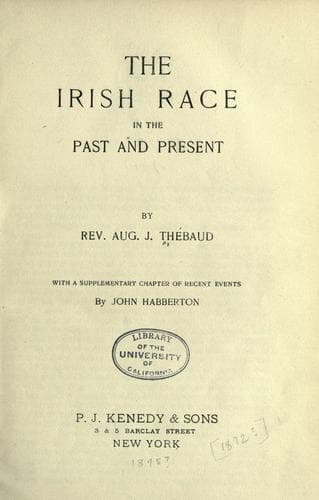
The Irish Race in the Past and the PresentThébaud, Augustus J.
History
The Irish Race in the Past and the Present
Thébaud, Augustus J.
Ireland -- History
There is no doubt that, if these laws of Kilkenny could have
been enforced and carried out, as they were meant to be, the
effect hoped for by these legislators might have been the
natural result. Yet even much later on, at a period, too, when
the English power was considerably increased, under Henry VIII.,
a very curious discussion of this possibility, which took place
at the time, did not by any means promise an easy realization.
The following passage of the "State Papers," under the great
Tudor, contains a rather sensible view of the subject, and is
not so sanguine of the success of the hopes cherished by the
attorney-general of James I.:
"The lande is very large--by estimation as large as Englande--so
that, to enhabit the whole with new inhabiters, the number would
be so great that there is no prince christened that commodiously
might spare so many subjects to depart out of his regions. . . .
But to enterprise the whole extirpation and totall destruction
of all the Irishmen of the lande, it would be a marvellous and
sumptuous charge and great difficulty, considering both the lack
of enhabitors, and the great hardness and misery these Irishmen
can endure, both of hunger, colde, and thirst, and evill lodging,
more than the inhabitants of any other lande."
There were, therefore, evidently difficulties in the way; yet it
is certain that the question of the total extirpation of the
Irish has been entertained for centuries by a class of English
statesmen, and confidently looked for by the English nation. Sir
John Davies, as we see, attributes no other object to the
Statutes of Kilkenny.
But could those statutes be enforced? were they ever enforced?
The same writer pretends that they were for "several years;" but
the sequel proves that they were not. The reason which he
assigns for their execution--that for a certain time after that
Parliament there was peace in the island--leads us to believe
the contrary; for if, as he himself justly remarks before, the
intention of the legislators was to create a perpetual
separation and enmity between the two races, the promulgation
and strict execution of those statutes would have immediately
enkindled a war which could have ended only with the total
extirpation of one race or the other.
And the further fact that it was thought necessary to reenact
those odious laws frequently in subsequent Irish Parliaments
proves that they were not carried into execution, since new
legislation on the subject was demanded.
Public-domain text, read in full here on John Shaqi.
Reviews
Reviews
No reviews yet
Be the first to share your thoughts on this work.
Elsewhere in the archive
Join the Discussion
Join the discussion
Sign in to leave a comment or review.
Sign InorCreate an account