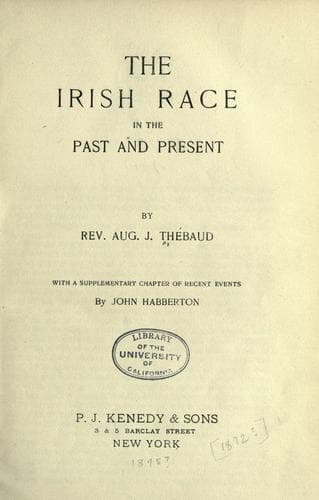
The Irish Race in the Past and the PresentThébaud, Augustus J.
History
The Irish Race in the Past and the Present
Thébaud, Augustus J.
Ireland -- History
It is true that events, transmitted to us either through the
Irish annals or the English chronicles, show that several
attempts were made to enforce those acts of Kilkenny, chiefly
against the Fitz-Thomases or Geraldines of Desmond, who
pretended, even after their enactment, to be as independent of
them as before, and refused to attend the Parliament when
convoked, claiming the strange privilege "that the Earls of
Desmond should never come to any Parliament or Grand Council, or
within any walled town, but at their will or pleasure." And the
Desmonds continued in their persistent opposition to the English
laws until the reign of Elizabeth.
But it was against Churchmen chiefly that they were carried out
in full; for we occasionally meet in the annals of the country
with instances where some English prelate in Ireland had been
prosecuted for having conferred orders on mere Irishmen, and
that some Norman abbots had been deposed for having received
mere Irishmen as monks into their monasteries.
With the exception of a few cases of this kind, no proof can be
furnished that any material change was brought about in the
relations of the old English settlers with their Irish neighbors.
In fact, matters progressed so favorably in this friendly
direction, that at length the descendants of Strongbow and his
followers became, as is well known, "Hibernis Hiberniores," and
the judges sent from England could hold their circuit only in
the four counties between the Liffey and the Boyne; and the name
given to the majority of the old English families was "English
rebels," while the natives were called "Irish enemies."
Sir John Davies himself is forced to admit it: "When the civil
government grew so weak and so loose that the English lords
would not suffer the English laws to be executed within their
territories and seigniories, but in place thereof both they and
their people embraced the Irish customs, then the state of
things, like a game at Irish, was so turned about, that the
English, who hoped to make a perfect conquest of the Irish, were
by them perfectly and absolutely conquered, because Victi
victoribus leges dedere."
The truth could not be expressed in more explicit terms. Yet all
has not been said. The same persevering character, making
headway against apparently insurmountable obstacles, shows
itself conspicuously in the Irish, in the preservation of their
land, which, after all, was the great object of contention
between the two races.
The first Anglo-Norman invaders, including Henry II himself, had
no other object in view than gradually to occupy the whole
territory, subject it to the feudal laws, give to Englishmen the
position of feudal lords, and reduce the Irish to that of
villeins, if they could not succeed in rooting them out.
Public-domain text, read in full here on John Shaqi.
Reviews
Reviews
No reviews yet
Be the first to share your thoughts on this work.
Elsewhere in the archive
Join the Discussion
Join the discussion
Sign in to leave a comment or review.
Sign InorCreate an account