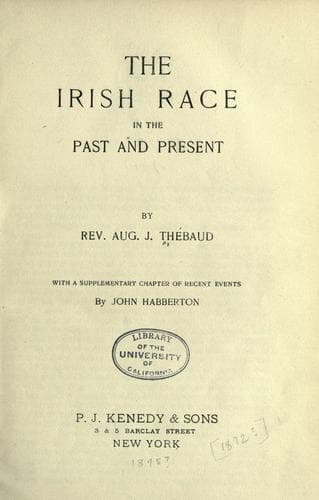
The Irish Race in the Past and the PresentThébaud, Augustus J.
History
The Irish Race in the Past and the Present
Thébaud, Augustus J.
Ireland -- History
A few years later, by the Treaty of Windsor, the king seemed to
confine his pretensions to Leinster, and perhaps Meath, and
expressly allowed the natives to keep their lands in the other
districts of the island. Yet none of his former grants, by which
"he had cantonned the whole island between ten Englishmen," were
recalled; the continued as part of and means to shape the policy
of the invaders, and subsequent Parliaments always supposed the
validity of those former grants made to Strongbow and his
followers.
It is true that those posterior Acts of Parliament did not
merely rely for their strength on the first documents, but on
the pretence that the Irish chieftains and people outside of
Leinster and Meath had justly forfeited their estates by not
fulfilling the conditions virtually contained in the Windsor
Treaty, in which they had professed homage and submission to the
English king. It is clear that, lawfully or unlawfully, the
Anglo-Normans were determined to gain possession, sooner or
later, of the whole island.
To secure their end, they declared that the natives would not be
subject to the English laws, but retain their Brehon laws, which
in their eyes were no laws at all, and which the Parliament of
Kilkenny had declared to be "lewd customs." Henceforth, then,
the natives were out of the pale of the law, could not claim its
protection, but became subject to the crown of England, without
political, civil, or even human rights.
They were soon, by reason of the constant border wars all around
the Pale, declared "alien and enemies." And these expressions
became, in the eyes of the English lawyers, identical with the
Irish race and the Irish nature; so that at all times, peace or
war, even when the Irish fought in the English ranks, aiding the
Plantagenets in their furious contests with the Scotch or the
French, they were still "Irish enemies;" "aliens" unworthy human
rights, villeins in whose veins no noble blood could flow, with
the exception of five families.
All the rest were not only ignoble, but not even men; nothing
but mere Irish, whom any one might kill, even though serving
under the English crown, at a risk of being fined five marks, to
be paid to the treasury of the King of England, for having
deprived his majesty of a serviceable tool.
This (to modern eyes) astounding social state demands a closer
examination in order to see if, at least, it had the merit of
finally procuring for the English the possession of the land
they coveted.
We find first that Henry II., John, and Henry III., would seem
on several occasions to have extended the laws of England all
over the island. But all English legists will tell us that those
laws were only for the inhabitants of English blood. The mere
Irish were always reputed aliens, or, rather, enemies to the
crown, so that it was, " by actual fact, often adjudged no
felony to kill a mere Irish in time of peace," as Sir John
Davies expressly points out.
Public-domain text, read in full here on John Shaqi.
Reviews
Reviews
No reviews yet
Be the first to share your thoughts on this work.
Elsewhere in the archive
Join the Discussion
Join the discussion
Sign in to leave a comment or review.
Sign InorCreate an account