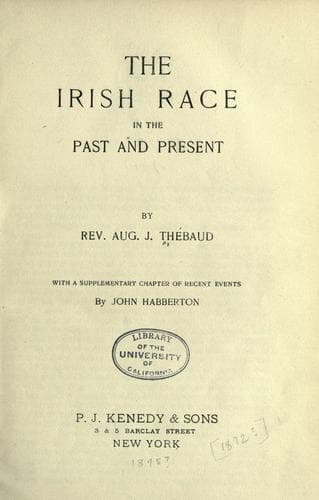
The Irish Race in the Past and the PresentThébaud, Augustus J.
History
The Irish Race in the Past and the Present
Thébaud, Augustus J.
Ireland -- History
Five families alone were excepted from the general category and
acknowledged to be of noble blood--the O'Neills of Ulster, the
O'Melachlins of Meath, the O'Connors of Connaught, the O'Briens
of Munster, and the McMurroughs of Leinster.
Those five families, numerous certainly, but forming only as
many septs, were, or appeared to be, acknowledged as having a
right to their lands, and as able to bring or defend actions at
law. We say, appeared to be, because they found themselves on so
many occasions ranked as mere Irish, that individuals of those
septs, induced by sheer necessity, were often driven, in spite
of an almost invincible repugnance, to apply for and accept
special charters of naturalization from the English kings. Thus
in the reign of Edward IV., O'Neill, on the occasion of his
marriage with a daughter of the house of Kildare, was made an
English citizen by special act of Parliament.
In reality then, even the most illustrious members of the "five
bloods" were scarcely considered as enjoying the full rights of
the lowest English vassals, although their ancestors had been
acknowledged kings by former Anglo-Norman monarchs in public
documents: "Rex Henricus regi O'Neill," etc.
But if there was some shadow of doubt with regard to the
political and social rights of those great families, such doubt
did not exist for the remainder of the Irish race. They were
absolutely without rights. Depriving them of their lands,
pillaging their houses, devastating their farms, outraging their
wives and daughters, killing them, could not subject the guilty
to any civil or criminal action at law. In fact, as we have
shown, such acts were in accordance with the spirit, even with
the letter of the law, so that the criminal, as we should
consider him, had but to plead that the man whom he had robbed
or killed was a mere Irishman, and the proceedings were
immediately stopped, if this all-important fact were proved; and
in case of homicide the murderer escaped by the payment of the
fine of five marks to the treasury.
To modern, even to English ears, all this may sound incredible.
Many striking examples of the truth of it might be produced.
They are to be found in all works which treat of the subject.
Sir John Davies, that great Irish hater, evidently takes a
genuine delight in depicting several such instances with all
their aggravating details, scarcely expecting that every word he
wrote would serve to brand forever with shame Anglo-Norman
England.
Under such legislation it was clear that life on the borders of
the Pale was not only insecure, but that the soil would remain
in the grasp of the strongest. Any Anglo-Norman only required
the power in order to take possession of the land of his
neighbor.
Public-domain text, read in full here on John Shaqi.
Reviews
Reviews
No reviews yet
Be the first to share your thoughts on this work.
Elsewhere in the archive
Join the Discussion
Join the discussion
Sign in to leave a comment or review.
Sign InorCreate an account