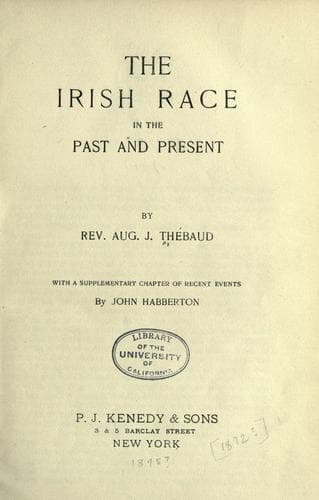
The Irish Race in the Past and the PresentThébaud, Augustus J.
History
The Irish Race in the Past and the Present
Thébaud, Augustus J.
Ireland -- History
But it is not in man's nature to submit to such galling thraldom
as this, without at least an attempt at retaliation. Least of
all was it the nature of such a people to submit to such
measures--a nation, the most ancient in Europe, dating their
ownership of the soil as far back as man's memory could go,
civilized before Scandinavia became a nest of pirates,
Christianized from the fifth century, and the spreader of
literature, civilization, and the holy faith of Christ through
England, Scotland, Germany, France, and Northern Italy.
If we have dwelt a little, and only a little, upon the intensity
of the contest waged for four hundred years previous to the
added atrocities introduced by the Reformation, we have done so
advisedly, since it has become a fashion of late to throw a
gloss over the past, to ignore it, to let the dead bury their
dead--all which would be very well, could it be done, and could
writers forget to stamp the Irish as unsociable, barbarous, and
bloodthirsty, because with arms in their hands, and a fire
ardent and sacred in their souls, they strove again and again to
reconquer the territory which had been won from them by fraud,
and because they thought it fair to kill in open fight the men
who avowed that they could kill them even in peace at a penalty
of five marks.
The contest, therefore, never ceased; how could it ? But, in
that endless conflict between the two races, the loss of
territory leaned rather to the English side. If, with the help
of their castles, better discipline, and arms, the English at
first gained on the natives and extended their possessions
beyond the Pale, a reaction soon set in--the Irish had their day
of revenge, and entered again into possession of the land of
which they had been robbed. In order to repair their losses, the
Anglo-Normans had recourse to acts of Parliament, which could
bind not only the English of the Pale, but also those of other
districts, who, enjoying the privileges of English law, were
likewise bound by its provisions.
In order rightly to understand the need and purposes of those
enactments, we must return a moment to the days of the conquest.
Public-domain text, read in full here on John Shaqi.
Reviews
Reviews
No reviews yet
Be the first to share your thoughts on this work.
Elsewhere in the archive
Join the Discussion
Join the discussion
Sign in to leave a comment or review.
Sign InorCreate an account