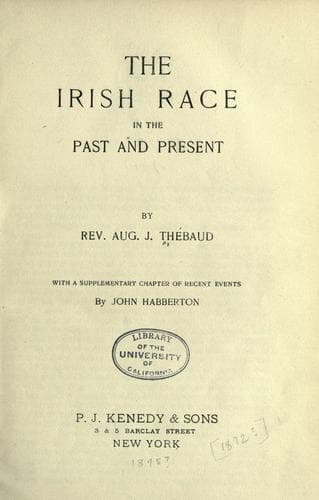
The Irish Race in the Past and the PresentThébaud, Augustus J.
History
The Irish Race in the Past and the Present
Thébaud, Augustus J.
Ireland -- History
The case of Strongbow will illustrate many others. He married
Eva, the daughter of McMurrough, and thus allied himself to the
best families of Leinster. On the death of his father-in-law, he
received the whole kingdom as his inheritance. The greater part
of his dominions, which he either would not or could not govern
himself, he was compelled to distribute, in the usual style,
among his followers. He distributed large estates as _fiefs_
among those who had followed his fortunes, but he could not
forget his Irish relatives, to whom he had become strongly
attached. He secured, therefore, to many Irish families the
territory which was formerly theirs, and many of his English
adherents, who, like himself, had married daughters of the soil,
did the same in their more limited territories. This explains
fully why Irish families remained in Leinster after the
settlement of the Anglo-Normans there, who established their
Pale in it, as also why they continued to possess their lands in
the midst of the English as they had formerly done in the midst
of the Danes.
The same thing took place in the kingdom of Cork, on the borders
of Connaught, and around the seaports of Ulster, wherever the
English had established themselves and erected castles and
fortifications.
But, over and above the Irish families, which, by their alliance
by marriage and fosterage with the English, retained their lands
and gradually increased them, many others, natives of the soil,
reentered into possession of their former territory by the
withdrawal of the Anglo-Norman holders of fiefs. Constant border
wars, the necessary consequence of the English policy, could not
but discourage in course of time many Englishmen, who, owning
large possessions also in England and Wales, preferred to return
to their own country rather than remain with their wives and
children in a constant state of alarm, compelled to reside
within their castles, in dread of an attack at any moment from
their Irish neighbors.
Moreover, the vast majority of the Irish, who did not enjoy the
benefit of these special privileges, who, deprived of their
lands at the first invasion, had remained really _outlaws_, and
never entered into matrimonial or social alliance with their
enemies, these men could not consent to starve and perish on
their own soil, in the island which they loved and from which
they could not--had they so chosen--escape by emigration. One
resource remained to them, and they grasped at it. They had
their own mountain fastnesses and bogs to fly to, and from those
recesses they could harass the invader, and inch by inch win
back their lawful inheritance.
Public-domain text, read in full here on John Shaqi.
Reviews
Reviews
No reviews yet
Be the first to share your thoughts on this work.
Elsewhere in the archive
Join the Discussion
Join the discussion
Sign in to leave a comment or review.
Sign InorCreate an account