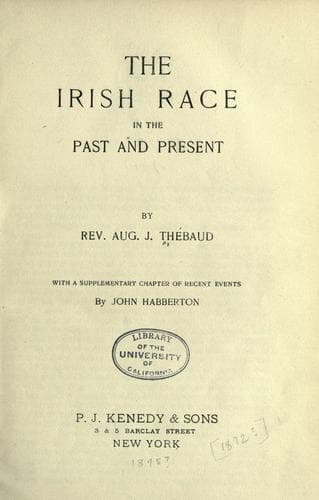
The Irish Race in the Past and the PresentThébaud, Augustus J.
History
The Irish Race in the Past and the Present
Thébaud, Augustus J.
Ireland -- History
They were often even encouraged in their attacks and
depredations by the English of the Pale and out of it, who,
unwilling longer to submit to the grinding feudal laws and
exactions, could prevent the English judges, sheriffs,
escheators, and other king's officers from executing the law
against them, and thus they held out in their mountains, bogs,
and rocky crags, in the midst of the invaders of their soil.
A necessity arose then, on the part of the English rulers, of
adopting measures calculated to prevent a further acquisition of
territory by the Irish, if not to extend the English settlements.
They saw no other remedy than acts of Parliament, which they
thought would at least prevent the subjects of English blood
from assisting the Irish to reenter into possession, as was then
being done on so extensive a scale.
To effect this they revived the former statutes by which the
Irish were placed without the protection of the law, were
declared aliens and enemies, and were consequently denied the
right of bringing actions in any of the English courts for
trespasses on their lands, or for violence done to their persons.
They soon advanced a step beyond this. The Irish were forbidden
to purchase land, though the English were at liberty to occupy
by force the landed property of the Irish, whenever they were
strong enough to do so. An Irishman could acquire neither by
gift nor purchase a rood of land which was the property of an
Englishman. Thus, in every charter afterward granted to the few
Irishmen who applied for them, it was expressly stated that they
could purchase land for themselves and their heirs, which,
without this special provision, they could not do; while for an
Englishman to dispose of his landed property by will, gift, or
sale to an Irishman, was equivalent to forfeiting his estate to
the crown. The officers of the exchequer were directed by those
acts of Parliament to hold inquisitions for the purpose of
obtaining returns of such deeds of conveyance, in order to
enrich the king's treasury by confiscations and forfeitures; and
the statute-rolls, preserved to this day in Dublin and London,
show that such prosecutions often took place, with the
invariable result of forfeiture.
The decision of the courts was always in favor of the crown,
even in cases where the deed of conveyance or will was of no
benefit to the person in whose favor it was drawn, but simply a
trust for a third person of English race. And the great number
of cases in which the inquisitions were set aside, as appears
from the Parliament-rolls, for the finding having been malicious
and untrue--the parties complained of not being Irish but
English-- prove what we allege, namely, that an Irishman could
not take land by conveyance from an Englishman.
Public-domain text, read in full here on John Shaqi.
Reviews
Reviews
No reviews yet
Be the first to share your thoughts on this work.
Elsewhere in the archive
Join the Discussion
Join the discussion
Sign in to leave a comment or review.
Sign InorCreate an account