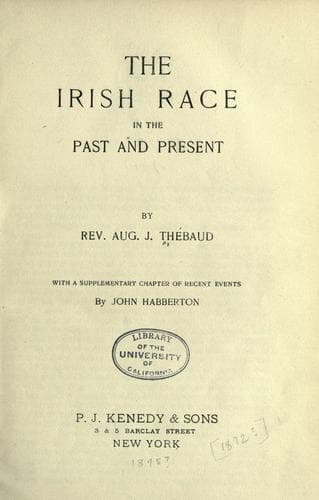
The Irish Race in the Past and the PresentThébaud, Augustus J.
History
The Irish Race in the Past and the Present
Thébaud, Augustus J.
Ireland -- History
Yet, as Mr. Prendergast justly says: "Notwithstanding these
prohibitions and laws of the Irish Parliament, the Irish grew
and increased upon the English, and the Celtic customs
overspread the feudal, until at length the administration of the
feudal law was confined to little more than the few counties
lying within the line of the Liffey and the Boyne."
Let us now glance, in conclusion, at the result of more than
four centuries of feudal oppression.
Ireland rejected feudalism from the beginning, and this at a
time when Europe had been compelled to adopt it, more or less,
throughout.
The distinction between lords and villeins, so marked in all
other countries, remained at the end as it was at the beginning
of the contest, a thing unknown in the island. Even in the Pale,
the presence of the O'Moores, O'Byrnes, O'Kavanaghs, and other
septs, protested against and openly denied, from moor and glen
and mountain fastness, that outrage on humanity, which bestows
on the few every thing meant for all. The Brehon law was in full
force all over the island, and if the Irish allowed the English
judges to ride on their circuits within the four counties, it
was on the full understanding that they would administer their
justice only to English subjects, and levy their feudal dues,
and pronounce their forfeitures and confiscations on such only
as acknowledged the king's right on the premises. The laws
enacted in the pretended Irish Parliament were only for such as
called themselves English by birth; for even the English by
blood, whose ancestors had long resided on the island,
frequently refused to submit to the laws of Parliament, where
they would not sit themselves, although possessing the right to
do so.
In vain was the threat of compulsion held up again and again
before the eyes of the great lords of Desmond, Thomond, and
Connaught. If they chose, they went; if they chose not, they
remained at home; and obeyed or disobeyed at will the laws
themselves, according as they were able or unable to set them at
defiance.
Public-domain text, read in full here on John Shaqi.
Reviews
Reviews
No reviews yet
Be the first to share your thoughts on this work.
Elsewhere in the archive
Join the Discussion
Join the discussion
Sign in to leave a comment or review.
Sign InorCreate an account