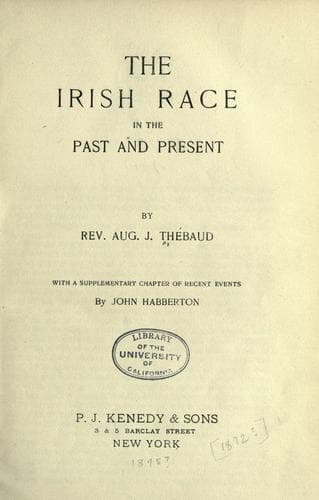
The Irish Race in the Past and the PresentThébaud, Augustus J.
History
The Irish Race in the Past and the Present
Thébaud, Augustus J.
Ireland -- History
The castles which had been built all over the country by the
first invaders, as a means of awing into subjection the
surrounding districts, were at the beginning of the fifteenth
century no longer feudal castles. They had either been
destroyed and levelled to the ground by the Irish, or they were
occupied by Irish chieftains; or, stranger still, if their
holders were English lords, they were of those who had been won
over to Irish manners. In their halls all the old customs of
Erin were preserved. One saw therein groups of shanachies, and
harpers, and Brehon lawyers, all conversing with their chieftain
in the primitive language of the country. Hence were they called
degenerate by the "foreigners" living in Dublin Castle. The
mansions of the Desmonds, of the Burgos, of the Ormonds, were
the headquarters of their respective clans, not the inaccessible
fortresses of steel-clad warriors, who alone were possessed of
social and civil rights. If the master of the household held
sometimes the title of earl, or count, or baron, he was careful
never to use it before his retainers, whom he called his
clansmen. When he went to Dublin or to London, he donned it with
the dress of a knight or a great feudal lord; on his return home
he threw it aside, resumed the cloak of the country, and was
Irish again.
The subject of feudal titles in Ireland has not been
sufficiently studied and elucidated. A clearer light thrown on
this question would, we have no doubt, show more conclusively
than long discussions with what stubbornness the Irish refused
to submit to the reality of feudalism, even when consenting to
admit its presence and phraseology. It is a fact not
sufficiently dwelt upon, that the few Irishmen, who subsequently
consented to receive English titles from the king, were regarded
by their countrymen with greater abhorrence than the English
themselves, though in most cases the titles were empty ones,
which affected nothing in their mode of life. Yet were they
looked upon as apostates to their nation, and after the
Reformation such a step was often the first to apostasy of
religion, the deepest stain on an Irish name.
Feudalism had also its mode of taxation which failed with the
rest in Ireland.
In feudal countries the lord imposed no tax on his villeins;
these were mere chattels, ascripti gleboe, who tilled the land
for their masters, and, as good serfs, could own nothing but the
few utensils of their miserable hovels. They were just allowed
what sufficed to support their own life and that of their
families, and consequently they could bear no additional tax.
But, in the complicated state of society brought about by
feudalism, the inferior lord was taxed by his superior, a system
that ran down the whole feudal scale, and it would take a lawyer
to explain aids, talliages, wardships, fines for alienation,
seizins, rents, escheats, and finally forfeiture, the heaviest
and most common of all in England.
Public-domain text, read in full here on John Shaqi.
Reviews
Reviews
No reviews yet
Be the first to share your thoughts on this work.
Elsewhere in the archive
Join the Discussion
Join the discussion
Sign in to leave a comment or review.
Sign InorCreate an account