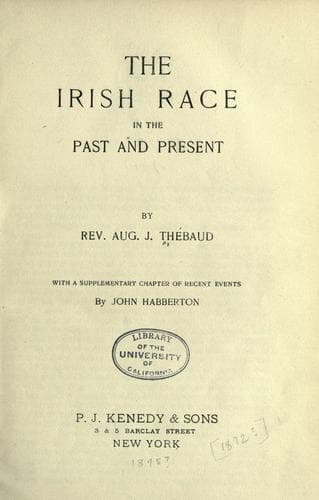
The Irish Race in the Past and the PresentThébaud, Augustus J.
History
The Irish Race in the Past and the Present
Thébaud, Augustus J.
Ireland -- History
The Irish fought valiantly against the imposition of those
burdens, and aided the English settled among them to repudiate
them all in course of time.
It must be said, however, that they did not succeed in
preventing their own taxes, according to the Book of Rights,
from becoming heavier under the ingenuity of the English who
were established among them and admitted to all the rights of
clanship. We see by documents which have been better studied of
late, that the great Anglo-Irish lords had succeeded in
increasing the burdens in the shape of exactions, which were
never complained of by the Irish.
On this subject Dr. O'Donovan, in the preface to his edition of
the "Book of Rights," is worthy of perusal.
But it is chiefly in the very essence of feudalism that the
failure of the Anglo-Normans was most signal. Feudalism really
consisted in the status given to the land, the possession of
which determined and gave all rights, so that, according to it,
man was made for the land rather than the land for man. He was
placed on the land with the beasts of the field as far as
tillage and production went, until the system should round to
perfection and finally bring to the surface the new principles
of social economy, according to which the greater the number of
cattle and the fewer the number of men, the more prosperous and
happy might the country be said to be.
The Irish staked their existence against those principles, and
won. So complete was their victory that the feudal barons who
first came among them finally yielded to clanship, became the
chiefs of new clans, and opened their territories to all who
chose to send their horses and kine to graze in the chief's
domains. In vain did Irish Parliaments issue writs of forfeiture
against the English lords who acted thus, for between the law
and its execution the clans intervened, and no sheriff or judge
could step beyond the bounds of the four counties of the Pale to
enforce those acts.
It is told of one of the Irish chieftains that on receiving
intimation from a high English official of a sheriff's visit on
the next breach of some new law or ordinance, for the safety of
which sheriff he would be held responsible, he replied: "You
will do well to let me know at the same time what will be the
amount of his _eric_, in case of his murder, that I may
beforehand assess it on the clan."
This story may tend better than any thing else to give a clear
reason for the failure of feudalism in Ireland.
CHAPTER VII.
IRELAND SEPARATED FROM EUROPE.-A TRIPLE EPISODE.
Public-domain text, read in full here on John Shaqi.
Reviews
Reviews
No reviews yet
Be the first to share your thoughts on this work.
Elsewhere in the archive
Join the Discussion
Join the discussion
Sign in to leave a comment or review.
Sign InorCreate an account