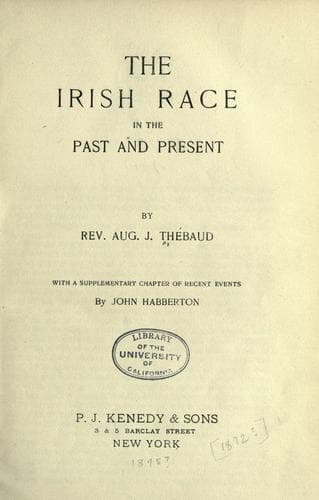
The Irish Race in the Past and the PresentThébaud, Augustus J.
History
The Irish Race in the Past and the Present
Thébaud, Augustus J.
Ireland -- History
While the struggle described in the last chapter was raging,
Ireland could have little or no intercourse with the rest of
Europe. Heaven alone was witness of the heroism displayed by the
free clans wrestling with feudal England. It was only during the
internecine wars of the Roses that Erin enjoyed a respite, and
then we read that Margaret of Offaly summoned to peaceful
contest the bards of the island, while the shrines of Rome and
Compostella were thronged with pilgrims, chiefs, and princes,
"paying their vows of faith from the Western Isle."
In the mean time Christendom had been witness of mighty events
in which Ireland could take no part. The enthusiastic impulse
which gave birth to the Crusades, the uprising of the communes
against feudal thraldom, the mental activity of numerous
universities, starting each day into life, form, among other
things, the three great progressive waves in the moving ocean of
the time:
I. When Europe in phalanx of steel hurled itself upon Asia and
saved Christendom from the yoke of Islam, when the Japhetic race
by a mighty effort asserted its right not merely to existence,
but to a preponderance in the affairs of the world, Ireland, the
nation Christian of Christians, had not a name among men. It was
supposed to be a dependency of England, and the envoys sent
abroad to all parts by the Holy See to preach the Crusades,
never touched her shores to deliver the cross to her warriors.
The most chivalrous nation of Christendom was altogether
forgotten, and in its ecclesiastical annals no mention is made
of the Crusades even by name.
The holy wars, moreover, were set on foot and carried on by the
feudal chivalry of Europe, and in fact, wherever the Europeans
established their power in the East, that power took the shape
of feudalism. But Ireland had rejected this system, and
consequently her sons could find no place in the ranks of the
knights of Flaners, Normandy, Aquitaine, and England. Their
chivalry was of another stamp, and was employed at the time in
wresting their social state and territory from the grasp of
ruthless invaders.
Hence, not even St. Bernard, the ardent friend of St. Malachi,
remembered them, when journeying through Europe to distribute
the Cross to whole armies of warriors. Not only did he fail to
cross the Channel for the purpose of rousing the Christian
enthusiasm of a people ever ready to hearken to a call to arms
when a noble cause was at stake; he did not think even of
writing a single letter to any bishop or abbot in Ireland,
asking them to preach the holy war in his name.
Thus Ireland failed to participate in any of the benefits which
accrued to the European nations from the Crusades, as she failed
likewise to participate in results less beneficial which also
accrued from that powerful agitation.
Public-domain text, read in full here on John Shaqi.
Reviews
Reviews
No reviews yet
Be the first to share your thoughts on this work.
Elsewhere in the archive
Join the Discussion
Join the discussion
Sign in to leave a comment or review.
Sign InorCreate an account