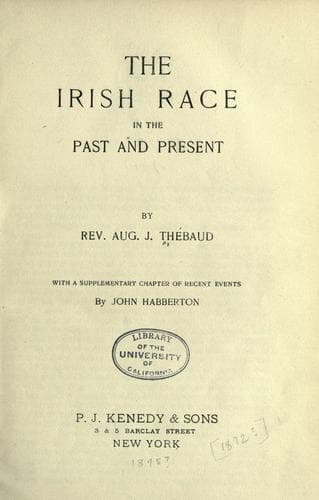
The Irish Race in the Past and the PresentThébaud, Augustus J.
History
The Irish Race in the Past and the Present
Thébaud, Augustus J.
Ireland -- History
In such an event, how was the heresy put down? Simply by the
good sense and spirit of faith of the people, or rather by the
deep Christian feeling of the native Irish, who were always
opposed to innovation, and who remained firm in the traditional
belief inherent in the nation by the grace of God. Schism and
heresy seem impossible among the children of Erin. If at any
time certain novelties have appeared among them, they have
speedily vanished like empty vapor. They heard that, in other
parts of the Church, in the East chiefly, heresiarchs had arisen
and led away into error large numbers of people forming
sometimes formidable sects, which threatened the very existence
of the religion of Christ; but the face of a heretic they had
never beheld. Soon, indeed, they were to be at the mercy of a
whole swarm of them, to see a pretended church leagued with the
state to bring about their perversion; but as yet they had had
no experience of the kind.
Only a few heretics were pointed out to them by the finger of
one of their bishops, and his denunciations were confirmed by
the judgment of the Holy See. Hence, according to F. Brenan,
"the sensation which pervaded all classes became vehement and
frightful. The bishop and his clergy came forward, and by solid
argument, by the strength and power of truth, opposed and
discomfited the enemies of religion."
The feeling here expressed is a natural one for a true Christian
at the very mention of heresy. Yet how few nations have
experienced a sensation "vehement and frightful" at the
appearance of positive error among them! But, at all periods of
their history, such has been the feeling of the Irish people.
Fortunately for them, the number of sectarians was so small as
to become insignificant; the English of the Pale were always few
in comparison with the natives, and heresy had been, adopted by
only a small body.
Error, therefore, could not cause in the island the social and
political convulsions which it had produced in France about the
same time. There was no need of a second Albigensian war to put
it down. There was no need even of the Inquisition, as an
ecclesiastical tribunal. The sentence of the bishop, the decree
of excommunication pronounced from the foot of the altar, was
all that was required.
Public-domain text, read in full here on John Shaqi.
Reviews
Reviews
No reviews yet
Be the first to share your thoughts on this work.
Elsewhere in the archive
Join the Discussion
Join the discussion
Sign in to leave a comment or review.
Sign InorCreate an account