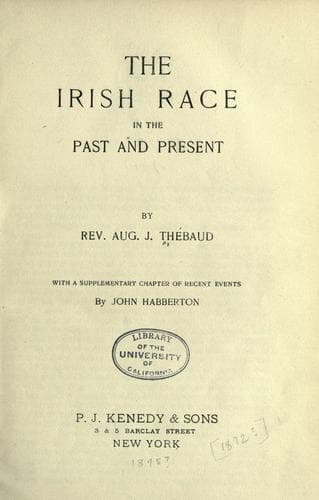
The Irish Race in the Past and the PresentThébaud, Augustus J.
History
The Irish Race in the Past and the Present
Thébaud, Augustus J.
Ireland -- History
When we compare this single fact of Irish ecclesiastical history
with what was then transpiring in Europe--the most insidious
errors spreading throughout; the faith of many becoming
unsettled, a general preparation for the social deluge which was
impending and so soon to fall--we cannot but conclude that
Ireland, in the midst of her misfortunes, was happy in being
separated from the rest of the world. The breath of novelty
could breathe no contagion on her shores. Happy even was she in
not seeing her sons enlist in the army of the Cross, if the
result of their victories was, to bring back from the Holy Land
the Eastern corruption and the many heresies nestling there and
settled, even around the sepulchre of our Lord, during so many
ages of separation from the West and open communication with all
the wild vagaries of Arabian, Persian, and Indian philosophies.
Even in the midst of such a trial we believe that Ireland would
have held steadfast to her faith, as she did later on when
heresy came to her with compulsion or death; and this firmness
of purpose, which the Irish have always manifested when the
question was a change of religion, is worthy our consideration.
For the facility with which some nations have, in the course of
ages, yielded to the spirit of novelty, and the sturdy
resistance opposed to it by others, is a subject that would
repay investigation, but which we can only slightly touch upon.
In ancient times the Greek mind, accustomed from the beginning
to subtlety of argument, and easily carried away by a
rationalism which was innate, offers a striking contrast to the
steady traditional spirit of the Latin races in general. Except
Pelagiaism and its cognate errors, all the great heresies which
afflicted the Church during the first ten centuries, originated
in the East; and the various sects catalogued by several of the
Greek Fathers, as early as the second and third centuries,
astonish the modern reader by the slender web on which their
often ridiculous systems are spun, of texture strong enough,
however, at the time to form the groundwork for making a
disastrous impression on a large number of adherents. The
infinity almost of philosophical systems in pagan Greece had
prepared the way for the subsequent vagaries of heresy, and we
must look to our own times, so prolific of absurd theories, in
order to find a parallel to the incredible variety of dogmatic
assertions among the Greek heresiarchs of early times.
Public-domain text, read in full here on John Shaqi.
Reviews
Reviews
No reviews yet
Be the first to share your thoughts on this work.
Elsewhere in the archive
Join the Discussion
Join the discussion
Sign in to leave a comment or review.
Sign InorCreate an account