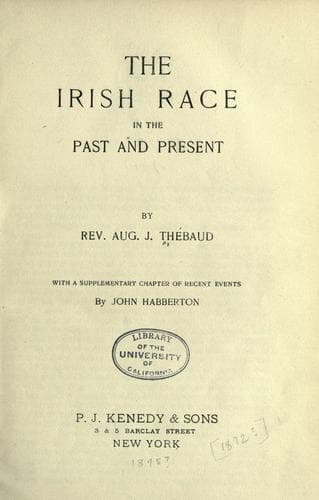
The Irish Race in the Past and the PresentThébaud, Augustus J.
History
The Irish Race in the Past and the Present
Thébaud, Augustus J.
Ireland -- History
But, at the outbreak of Protestantism, in the sixteenth century,
the world witnessed a still more striking example of diversity
in the various branches of the Japhetic family - the nations
belonging to the Teutonic and Scandinavian stocks chiefly
embracing the error at once with a wonderful spontaneity. The
various remnants of the Celtic race and the totality of the
Latin nations remained, on the whole, obedient to the guiding
voice of the Church of Christ. It is customary with modern
writers, when imbued with what are called liberal ideas, to
ascribe this difference to the steady, systematic mind of
northern nations, and to their innate love of liberty, which
could not brook the yoke of spiritual despotism imposed by the
Church of Rome. But all this is mere supposition, inadequate to
accounting for the fact. The Teutonic and Scandinavian mind is
certainly more systematic and apparently more steady than the
Celtic; but it is far less so than the Latin. No nation in the
whole history of mankind has ever displayed more steadiness and
system than the Romans, and the Latin family has inherited those
characteristics from Rome. The Spanish race has no equal in
steadiness (in the sense here intended of steadfastness), and
the French certainly none in system, which it often carried to
the verge of absurdity.
As for love of liberty, as distinct from love of license, it had
absolutely nothing to do with the great revolution which has
been called the Reformation. No nation can relish despotism, and
the whole history of Ireland is a living example that her sons
are steadily opposed to it to the death. And it is now too late
to pretend that the cause of true liberty has been served by the
spread of Protestantism over a large portion of Europe. Balmez
and others have proved the falsehood of such pretensions. If any
modern writers, such as Mr. Bancroft, for instance, men
otherwise of sound mind and great ability, continue to assert
this, the assertion must proceed from prejudice deeply ingrained,
which reflection has not yet succeeded in eradicating, and
their opinions on the subject are necessarily confined to bold
assertions, of a character which in others they themselves would
stigmatize as empty and unfounded.
The reason of the difference lies deeper in the constitution of
the human mind, in the Celtic and Latin races on the one side,
in the Teutonic and Scandinavian families on the other. Any one
who has studied the Irish character in our days--a character
which was the same in former ages--will easily see something of
that great and happy cause.
Public-domain text, read in full here on John Shaqi.
Reviews
Reviews
No reviews yet
Be the first to share your thoughts on this work.
Elsewhere in the archive
Join the Discussion
Join the discussion
Sign in to leave a comment or review.
Sign InorCreate an account