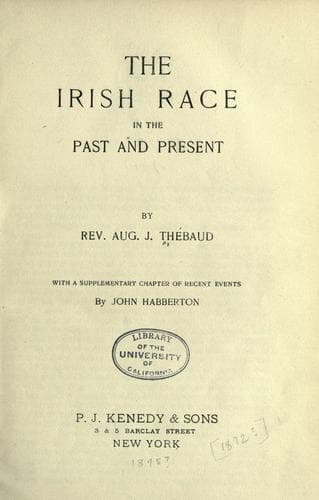
The Irish Race in the Past and the PresentThébaud, Augustus J.
History
The Irish Race in the Past and the Present
Thébaud, Augustus J.
Ireland -- History
The difference lies first in the good sense which enables them
to perceive instinctively that the eternal should be preferred
to the temporal. If all men kept that distinct perception ever
present to their minds, they would not only accept at all times
the truths of faith, since faith, according to St. Paul, is "the
substance of the things hoped for," but they would remain ever
faithful to the moral code given us by God. The Celt indeed will
at times lose sight of the eternal in the presence of a temporal
temptation; but he is never blind to the knowledge that faith is
the groundwork of salvation, and that hope remains as long as
that is not surrendered. Therefore he will never surrender it.
The need of reviving his faith is rarely called for, when, after
a life of sin, the shadow of death reminds him of the duty he
owes his own soul. The great truth that, after all, the ETERNAL
is every thing, remains always deeply impressed on his mind; and
half his labor is spared to the minister of God, when bringing
such a man back to a life of virtue. There is scarcely any need
of asking an Irishman, "Do you believe?" For, every word that
passes his lips, every look and gesture, every expression of
feeling, is in fact an act of faith. How easy after this is the
work of regeneration!
0 happy race, to whom this life is in truth a shadow that
passeth away! to whom the unseen is ever present, or comes back
so vividly and so readily!
This supposes, as we have said, a sound, good sense, which is
characteristic of the race. We may say that this nation
possesses the wisdom of Sir Thomas More, who esteemed it folly
to lose eternity for a life of twenty years of ease and honors.
Is not this, at bottom, the thought which has sustained the
nation in that dread martyrdom of three centuries, whose
terrible story we have still to tell? Have they not, as a nation,
one after another, generation upon generation, lived and passed
their lives in contempt, in want, in frightful misery, to die in
torments or hidden sufferings, without a gleam of hope from this
world for their race, their families, their children, their very
name, because they would not surrender their religion, that is
to say, truth, which alone could secure the eternal welfare of
their souls?
Speak to us, after this, of a steady and systematic mind! Prate
to us of the love of liberty, of self-dignity! Where are such
things to be found in their reality, on their trial, if not in
the scenes and the nation we have just pictured?
Public-domain text, read in full here on John Shaqi.
Reviews
Reviews
No reviews yet
Be the first to share your thoughts on this work.
Elsewhere in the archive
Join the Discussion
Join the discussion
Sign in to leave a comment or review.
Sign InorCreate an account