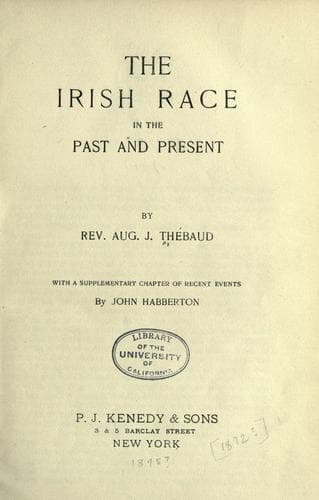
The Irish Race in the Past and the PresentThébaud, Augustus J.
History
The Irish Race in the Past and the Present
Thébaud, Augustus J.
Ireland -- History
A second reason, no less effective, perhaps, than the first, and
certainly as remarkable, is the very composition of the Celtic
mind, which naturally tends to firm belief, because it is given
exclusively to traditions, past events, narratives of poets,
historians, and genealogists. Had the Irish at any time turned
themselves to criticise, to doubt, to argue, their very
existence, as a people, would have ceased. They must go on
believing, or all reality vanishes from their minds, accustomed
for so many ages to take in that solid knowledge founded, it is
true, on hearsay; but how else can truth reach us save by
hearsay? Hence, their simple and artless acquiescence in any
thing they hear from trustworthy lips - acquiescence ever
refused to a known enemy, never to a well-tried friend, even
when the facts ascertained are strange, mysterious, unaccounted
for, and incredible to minds differently constituted.
Thus, when we read their "Acta Sanctorum," we at once find
ourselves in a world so different from our every-day world - a
region of wonders, mysteries, of heavenly and supernatural deeds,
unequalled in any story of marvellous travel or fable of
imaginative romance. Yet, who will say that the writers doubted
a single phrase of what they wrote? Is it not clear, from the
very words they use, that they would have held it sacrilege to
utter a falsehood, when speaking of the blessed saints? And, can
the lives of the saints be like those of common mortals? What is
there strange in considering that the earth was mysterious and
heavenly, when heavenly beings walked upon it? Read the Litany
and Festology of Aengus, and doubt if the holy man did not
believe all therein contained. Say, if it can be possible, that
it is not all true, though apparently incredible. Who can doubt
what is asserted with such vehemence of belief? How can that
fail to be true which holy men and women have themselves
believed, and given to the world to be believed?
This thoroughly explains the simplicity of faith which still
distinguishes the Irish people. It explains why no heretic could
be found among them, and their intense horror of heresy as soon
as known. Nor is it their mind alone which bears the impress of
faith: their very exterior is a witness to it. Go into any large
city where dwell a number of Irish inhabitants; walk through the
public streets, where they walk among the children of other
races, and you will easily distinguish them, not only by the
modesty of their women and the simple bearing of their men, but
by the look of confidence and contentedness stamped on their
features. Whoever has a settled faith, is no longer an inquirer,
no longer troubled with the anxiety and restlessness of a man
plunged in doubt and uncertainty; all the lineaments of the face,
all the gestures and attitudes of the body, speak of quietude
and repose.
Public-domain text, read in full here on John Shaqi.
Reviews
Reviews
No reviews yet
Be the first to share your thoughts on this work.
Elsewhere in the archive
Join the Discussion
Join the discussion
Sign in to leave a comment or review.
Sign InorCreate an account