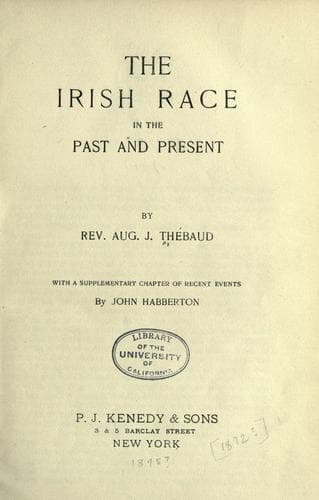
The Irish Race in the Past and the PresentThébaud, Augustus J.
History
The Irish Race in the Past and the Present
Thébaud, Augustus J.
Ireland -- History
We might render this discussion more effective by the study of
the contrary phenomena, by showing how easily races, differently
gifted, endowed with the spirit of criticism and argument, sever
from the faith and follow the lead of deceptive teachers. Our
object here was to describe the Irish, and not to enter into a
study of the physiology of other minds; but a word on Germanic
and Scandinavian tribes and peoples may not be amiss.
There is no doubt that these races place their "good sense" in a
very different line from the Irish; that they are, also, much
more given to criticism, what they call "grumbling," and absence
of repose.
With regard to the first point - their "good sense" - it is easy
to remark their tendency to prefer the temporal to the eternal.
For their "good sense" consists in enjoying the things of this
life without troubling themselves over-much about another. And,
in this observation, there is nothing which can possibly offend
them, for such is their open profession and estimate of true
wisdom. Hence result their love of comfort, their thrift, their
shrewdness in all material and worldly affairs; hence, their
constant boasting about their civilization, understanding,
thereby, what is pleasing to the senses; hence, also, their
success in a life wherein they set their whole happiness. How
could they be expected to remain steadfast to a faith which
declares war to pleasure, and speaks only of contempt for this
world? It is not matter of surprise, then, that their great
argument, to prove that theirs is the better and the right
religion, is to compare their physical well-being with the
inferiority in that regard of Catholic nations.
With regard to the spirit of criticism and argumentation,
nothing is so opposed to the spirit of faith; and it is as clear
as day that the northern races possess this in an eminent degree.
What question, religious or philosophical, can rest intact when
brought under the microscopic vision of a German philosopher or
an English rationalist? A few years more of criticism, as now
understood and practised by them, would leave absolutely nothing
which the mind of man could respect and believe.
An attentive observer will surely conclude, after a serious
examination of the subject, that it is from petty causes of this
character that these races have so easily surrendered their
faith, rather than from their systematic minds and love of
liberty.
Public-domain text, read in full here on John Shaqi.
Reviews
Reviews
No reviews yet
Be the first to share your thoughts on this work.
Elsewhere in the archive
Join the Discussion
Join the discussion
Sign in to leave a comment or review.
Sign InorCreate an account