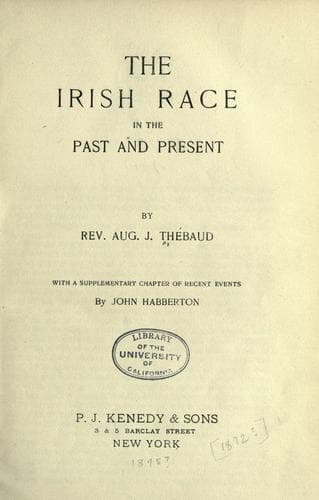
The Irish Race in the Past and the PresentThébaud, Augustus J.
History
The Irish Race in the Past and the Present
Thébaud, Augustus J.
Ireland -- History
When we compare the vast despotisms of Asia, crystallized into
forms which have scarcely changed since the first settlement of
man in those immense plains, with the active and ever-moving
smaller groups of Europeans settled in the west of the Old World
since the dispersion of mankind, we see at a glance how the
characters of both may be read in their respective annals. And,
coming down gradually to less extreme cases, we recognize the
same phenomenon manifested even in contiguous tribes, springing
long ago, perhaps, from the same stock, but which have been
formed into distinct nations by distinct ancestors, although they
acknowledge a common origin. The antagonism in their character is
immediately brought out by what historians or annalists have to
say of them.
Are not the cruelty and rapacity of the old Scandinavian race
Still visible in their descendants? And the spirit of organization
displayed by them from the beginning in the seizure, survey, and
distribution of land--in the building of cities and castles--in
the wise speculations of an extensive commerce--may not all these
characteristics be read everywhere in the annals of the nations
sprung from that original stock, grouped thousands of years ago
around the Baltic and the Northern Seas?
How different appear the pastoral and agricultural tribes which
have, for the same length of time, inhabited the Swiss valleys and
mountains! With a multitude of usages, differing all, more or less,
from each other; with, perhaps, a wretched administration of
internal affairs; with frequent complaints of individuals, and
partial conflicts among the rulers of those small communities--with
all these defects, their simple and ever-uniform chronicles reveal
to us at once the simplicity and peaceful disposition of their
character; and, looking at them through the long ages of an obscure
life, we at once recognize the cause of their general happiness in
their constant want of ambition.
And if, in the course of centuries, the character of a nation has
changed--an event which seldom takes place, and when it does is
due always to radical causes--its history will immediately make
known to us the cause of the change, and point out unmistakably
its origin and source.
Public-domain text, read in full here on John Shaqi.
Reviews
Reviews
No reviews yet
Be the first to share your thoughts on this work.
Join the Discussion
Join the discussion
Sign in to leave a comment or review.
Sign InorCreate an account