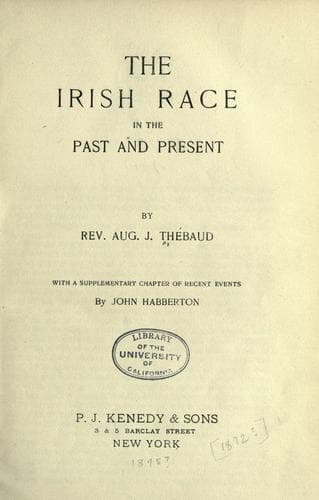
The Irish Race in the Past and the Present — John Shaqi
The Irish Race in the Past and the PresentThébaud, Augustus J.
History
The Irish Race in the Past and the Present
Thébaud, Augustus J.
Ireland -- History
Why is it, for instance, that the French nation, after having lived
for near a thousand years under a single dynasty, cannot now find
a government agreeable to its modern aspirations? It is insufficient
to ascribe the fact to the fickleness of the French temper. During
ten centuries no European nation has been more uniform and more
attached to its government. If to-day the case is altogether
reversed, the fact cannot be explained except by a radical change
in the character of the nation. Firmly fixed by its own national
determination of purpose and by the deep studies of the Middle
Ages--nowhere more remarkable than in Paris, which was at that
time the centre of the activity of Catholic Europe--the French
mind, first thrown by Protestantism into the vortex of controversy,
gradually declined to the consideration of mere philosophical
utopias, until, rejecting at last its long-received convictions,
it abandoned itself to the ever-shifting delusions of opinions and
theories, which led finally to skepticism and unbelief in every
branch of knowledge, even the most necessary to the happiness of
any community of men. Other causes, no doubt, might also be assigned
for the remarkable change now under our consideration. The one we
have pointed out was the chief.
To the same causes, acting now on a larger scale throughout Europe,
we ascribe the same radical changes which we see taking place in
the various nations composing it: every thing brought everywhere
in question; the mind of all unsettled; a real anarchy of intellect
spreading wider and wider even in countries which until now had
stood firm against it. Hence constant revolutions unheard of
hitherto; nothing stable; and men expecting with awe a more
frightful and radical overturning still of every thing that makes
life valuable and dear.
Are not these tragic convulsions the black and spotted types
wherein we read the altered character of modern nations; are they
not the natural expression of their fitful and delirious life?
These considerations, which might be indefinitely prolonged, show
the truth of the phrase of Joseph de Maistre that "all nations
manifest a particular and distinctive character, which deserves
to be attentively considered."
The fact is, in this kind of study is contained the only possible
philosophy of history for modern times.
With respect to ages that have passed away, to nations which have
run their full course, a nobler study is possible--the more so
because inspired writers have traced the way. Thus Bossuet wrote
his celebrated "Discours." But he stopped wisely at the coming of
our Lord. As to the events anterior to that great epoch, he spoke
often like a prophet of ancient times; he seemed at times to be
initiated in the designs of God himself. And, in truth, he had
them traced by the very Spirit of God; and, lifted by his elevated
mind to the level of those sublime thoughts, he had only to touch
them with the magic of his style.
Public-domain text, read in full here on John Shaqi.
Reviews
Reviews
No reviews yet
Be the first to share your thoughts on this work.
Join the Discussion
Join the discussion
Sign in to leave a comment or review.
Sign InorCreate an account