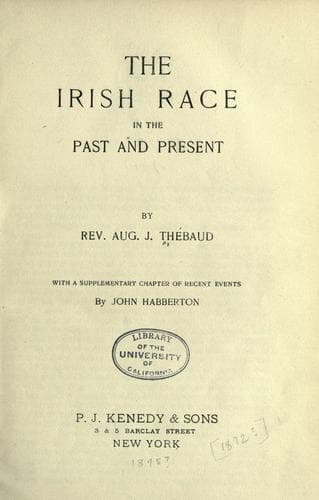
The Irish Race in the Past and the PresentThébaud, Augustus J.
History
The Irish Race in the Past and the Present
Thébaud, Augustus J.
Ireland -- History
This feature of the Irish assemblies, even when no
representative of the native race sat in them, was a fatal
obstacle to the success of the scheme devised by Browne and
executed by Cromwell. Accordingly, we are not astonished to find
that, by an act of despotism not uncommon during the reign of
Henry VIII., the proctors were excluded from Parliament, which
thus became an obedient tool in the hands of the government.
Not only, therefore, were several state measures carried in
accordance with the wish of the king, but the great object
proposed by the meeting of this assembly was finally obtained;
and, lowing the lead of the English Parliament, Henry VIII. and
his successors were confirmed in the title of "Supreme Head of
the Church in Ireland," with power of reforming and correcting
errors in religion. All appeals to Rome were prohibited, and the
Pope's authority declared a usurpation.
Henry, however, foreseeing that all these favorite measures of
his policy, being carried by English votes in a purely English
assembly, though on Irish soil, would meet with universal
opposition from all the native lords, conceived the idea of
summoning the great Irish chieftains to a new meeting of
Parliament, from which he expected that a moral revolution would
be effected in the island. Sir Anthony St. Leger, created deputy
in August, 1540, was thought a likely man to be intrusted with
so delicate a mission. He conducted it with political prudence,
that is to say, with a judicious mixture of kindness and fraud,
which succeeded beyond all expectations.
In order to prepare the way for hoodwinking the Irish chieftains,
favors of every kind were showered upon them, to wit, titles
and estates, chiefly those of suppressed monasteries; and St.
Leger, by an alternate use of force and diplomacy, at length
effected that the Irish should consent to accept titles. Con
O'Neill, the head of the house of Tyrone, went to England,
accompanied by O'Kervellan, Bishop of Ologher, and was admitted
to an audience by the king. Henry adopted toward those proud
Irishmen a policy utterly different from that he had used with
the English lords. These latter were merely threatened with his
displeasure, and with the feudal penalties he knew so well how
to inflict; the others were received at court as favorites and
dear friends; a royal courtesy, kind expressions, a smiling face-
-such were the arms he employed against the "barbarous Irish."
Public-domain text, read in full here on John Shaqi.
Reviews
Reviews
No reviews yet
Be the first to share your thoughts on this work.
Elsewhere in the archive
Join the Discussion
Join the discussion
Sign in to leave a comment or review.
Sign InorCreate an account