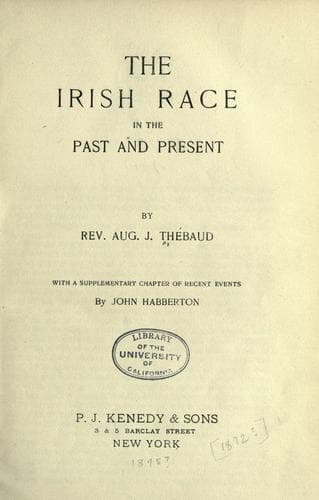
The Irish Race in the Past and the PresentThébaud, Augustus J.
History
The Irish Race in the Past and the Present
Thébaud, Augustus J.
Ireland -- History
Tyrone, O'Donnell, and others, were not proof against his
cunning. The first renounced his title of prince and the
glorious name of O'Neill, to receive in return that of Earl of
Tyrone. Manus O'Donnell was made Earl of Tyrconnel. Both
received back the lands which they had offered to the king, and
their example was followed by a great number of inferior lords.
Among them, two Magenisses were dubbed knights; Murrough O'Brien,
of North Munster, was made Earl of Thomond and Baron of
Inchiquin; De Burgo, or McWilliams, was created Earl of
Clanricard, and a host of others submitted in like manner, and
received the new titles which henceforth became conspicuous in
Irish history.
This was the beginning of the gradual suppression of the clans.
Many of these nobles, unfortunately, not content with receiving
back, at the hands of the king, the lands which had come into
their possession from a long line of ancestors, and which really
belonged not to them personally, but to the clans whose heads
they were, greedily snatched at the estates of religious orders,
whose suppression was the first consequence of the schism in
Ireland, which will soon occupy our attention.
The Irish chieftains had already seen Wolsey, a cardinal in full
communion with Rome, suppress forty monasteries in the island.
They might therefore imagine that the confiscation of a still
greater number on the part of the king was a thing not
altogether incompatible with the religion of the monarch, and
that the fact of their sharing in the plunder was not entirely
opposed to their titles of Catholics and subjects of Rome. Such
is human conscience when blinded by self-interest.
The king thought that he had gained over the nobility,--which
was all he wished- -and the last session of the previous
Parliament of 1536 and the following years might now be held in
order to consecrate the unholy work.
"On the 12th of June, 1541," says Mr. Haverty, "a Parliament was
held in Dublin, at which the novel sight was witnessed of Irish
chieftains sitting for the first time with English lords.
O'Brien appeared there by his procurators and attorneys, and
Kavanagh, O'More, O'Reilly, McWilliams, and others, took their
seats in person, the addresses of the Speaker and of the Lord-
Chancellor being interpreted to them in Irish by the Earl of
Ormond. An act was unanimously passed, conferring on Henry VIII.
and his successors the title of King of Ireland, instead of that
of Lord of Ireland, which the English kings, since
the days of John, had hitherto borne. This act was hailed with
great rejoicings in Dublin, and on the following Sunday, the
lords and gentlemen of Parliament went in procession to St.
Patrick's Cathedral, where solemn high mass was sung by
Archbishop Browne, after which the law was proclaimed and a Te
Deum chanted."
Public-domain text, read in full here on John Shaqi.
Reviews
Reviews
No reviews yet
Be the first to share your thoughts on this work.
Elsewhere in the archive
Join the Discussion
Join the discussion
Sign in to leave a comment or review.
Sign InorCreate an account