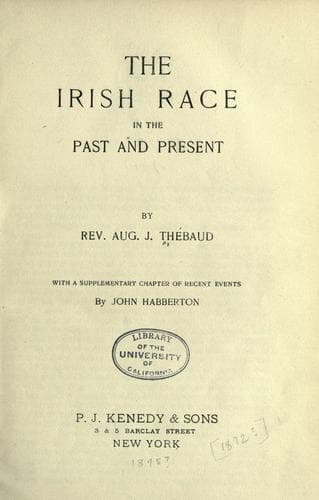
The Irish Race in the Past and the PresentThébaud, Augustus J.
History
The Irish Race in the Past and the Present
Thébaud, Augustus J.
Ireland -- History
It is worthy of remark that in the session of 1541, at which
alone the Irish chieftains appeared, not a word was said of the
supremacy of the king in spirituals. Sir James Ware, who gives
the various decrees with more detail than usual, makes no
mention of this pet measure of the king and of the Lutheran
Archbishop Browne, but it was only part and parcel of the
Parliament of 1536, prorogued successively to Kilkenny, Cashel,
Limerick, and finally again to Dublin. At its first sitting the
law of supremacy was passed and proclaimed as law of Ireland.
Nothing was said of it in the various sessions that followed,
including that of 1541; and yet the Irish chieftains were
supposed to have sanctioned it, inasmach as it was a measure
previously passed in the same Parliament: and the suppression of
various abbeys and monasteries having been openly decreed in the
final session, as a result of the king's supremacy--Rome not
having been consulted, of course--all the signers of the last
decree were supposed to have thereby sanctioned and adopted the
previous ones. Thus O'Neill, O'Reilly, O'More, and the rest,
without being aware of the fact, became schismatics, though many
of them, perhaps all, did not see the connection between the
various sessions of that long Parliament. Certainly, if, on
leaving the Dublin Cathedral, where they had heard the
archbishop's mass and assisted at that solemn Te Deum, they had
been told that that act was intended to consecrate the surrender
of the religion of their ancestors, and the commencement of a
frightful revolution, which would end in the destruction of
their national existence, almost of their very race, they would
have incredulously laughed to scorn the unwelcome prophet.
But even if, as we may well believe, those Irish lords had
really been the victims of deception, and had not, as a body,
been corrupted by the sacrilegious gift of suppressed
monasteries, the people, their clansmen, prompted by the vivid
impressions and unerring instincts of religious faith and
patriotic nationality, which were ever living in their breasts,
resented the weakness of their chieftains as a national
defection and a real apostasy, and took immediate steps to bring
the lords to their senses, and to prevent the spread of English
corruption.
Public-domain text, read in full here on John Shaqi.
Reviews
Reviews
No reviews yet
Be the first to share your thoughts on this work.
Elsewhere in the archive
Join the Discussion
Join the discussion
Sign in to leave a comment or review.
Sign InorCreate an account