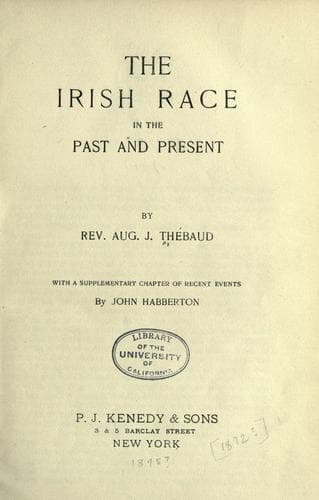
The Irish Race in the Past and the PresentThébaud, Augustus J.
History
The Irish Race in the Past and the Present
Thébaud, Augustus J.
Ireland -- History
All who had received titles from Henry, and surrendered to him
the deeds of their lands, as if those lands belonged to them
personally, and not to the clans collectively, all those,
particularly, who had enriched themselves by the plunder of
religious houses, and who had taken any part in the destruction
of the religious orders so dear to the Irish heart, were soon
made to feel the indignation which those events had excited
among the native clansmen, north and south. And those of the
chieftains who had really been deceived, and had preserved in
their hearts all through a strong love for their religion and
country, were recalled to a sense of their error, and brought
back to a sense of their duty by the unmistakable voice of the
"people."
While the nobles were still in England, feted by Henry in his
royal palace of Greenwich, renouncing their Irish names to
become English earls and barons, the Ulster chief, protesting
that he would never again take the name of O'Neill, but content
himself with the title of Earl of Tyrone; while O'Brien was
being created Earl of Thomond; McWilliams, Earl of Clanricard;
O'Donnell, Earl of Tyrconnell; Kavanagh, Baron of Ballyann; and
Fitzpatrick, Baron of Ossory; the clans at home, hearing in due
time of those real treasons, were concerting plans for making
their lords repent of their weakness or treachery, and for
administering to them due punishment on their return.
O'Neill, "the first of his race who had accepted an English
title," on landing in Ireland, learned that, his people had
deposed him, and elected in his stead his son John the Proud,
better known as Shane O'Neill; O'Donnell, on his arrival, met
most, of his clan, headed by his son, up in arms against him;
the new Earl of Clanricard had already been deposed by his
people and another McWilliams, with a Gaelic name, elected in
his place; and so with the rest.
But, unfortunately, the Government of England was strong enough
to support its favorite chieftains, and it found some Irish
tools ready at hand to form the nucleus of an Irish party in
their favor. Thus, unanimity no longer marked the decisions of
the clans; two parties were formed in each of them, the one
national, comprising the great bulk of the people, the real,
true people; the other English, composed of a few apostate
Irishmen, backed by the power of England. Thus, henceforth we
hear of the O'Reilly, and the king's O'Reilly, etc.
Public-domain text, read in full here on John Shaqi.
Reviews
Reviews
No reviews yet
Be the first to share your thoughts on this work.
Elsewhere in the archive
Join the Discussion
Join the discussion
Sign in to leave a comment or review.
Sign InorCreate an account