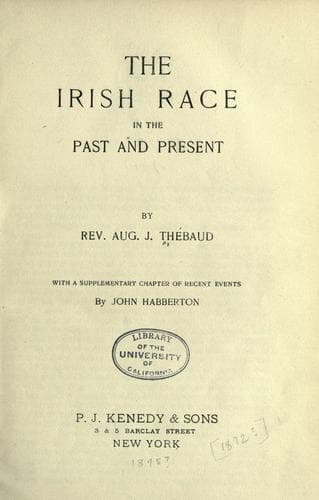
The Irish Race in the Past and the PresentThébaud, Augustus J.
History
The Irish Race in the Past and the Present
Thébaud, Augustus J.
Ireland -- History
Henry VIII. seemed, therefore, with the help of his minister, St.
Leger, to have succeeded in breaking up the clans, after the
Irish national government had been broken up long before.
Confusion of titles, property, and traditions became worse
confounded. How could the shanachies, bards, and brehons, any
longer agree in their pedigrees, songs, and legal decisions?
England had thus early adopted in Ireland the stern and
coldhearted policy which, centuries later, she used to destroy
the native and Mohammedan dynasties in Hindostan. It was not yet
divide et impera on a large scale, but the division was pushed
as far as lay in the power England, to the very last elements of
the social system.
From this time forward, then, we must not be surprised to find
England welcoming to her bosom unworthy sons of Ireland, whom
she wished to make her tools. There was always, either in Dublin
or London, a sufficient supply of materials out of which crown's
chiefs might be manufactured; the government made it part of its
policy to hold in its hands and train to its purposes certain
members of each of the ruling families--of the O'Neills,
O'Reillys, O'Donnells, O'Connors, and others.
It was no longer, therefore, the rooting out and exterminating
policy which prevailed, but one as fatal in its results, which
would have utterly destroyed Irish national feeling, to set up
in its place, not only English manners, language, and customs,
but also English schism, heresy, philosophical speculations --as
the Four Masters have it --finally, materialism and nihilism.
But, in real sober fact, the scheme proved almost an utter
failure, owing to the far-seeing good sense of the people. The
national spirit revived among the upper classes, both native and
of English descent--owing to the decided stand taken by the
inferior clansmen.
The Desmonds and Kildares, in the south, the O'Donnells,
Maguires, and others, in the north, soon showed themselves
animated by a new spirit of ardent Catholicism; created, in fact,
a new nation, quite apart from, or rather embracing, clanship,
well-nigh destroyed the English power, kept Elizabeth, during
the whole of her reign, in constant agitation and fear, and
would have succeeded in recovering their independence, and
securing freedom of worship, had not their good-nature been
imposed upon by the hypocrisy and faithlessness of the Stuarts,
to whom they always looked for freedom in the practice of their
religion, without ever obtaining it.
Thus did the people, the Irish race, thwart the policy of Henry,
who sought to gain over the nobility. Their stubborn resistance
to the vastly-increased and constantly-increasing English power,
grew at last to such proportions, and became so discouraging to
their oppressors, that the old policy of utter extermination was
resumed by Cromwell and the Orange party of the following age.
Public-domain text, read in full here on John Shaqi.
Reviews
Reviews
No reviews yet
Be the first to share your thoughts on this work.
Elsewhere in the archive
Join the Discussion
Join the discussion
Sign in to leave a comment or review.
Sign InorCreate an account