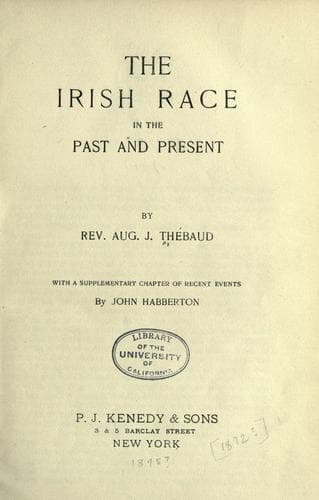
The Irish Race in the Past and the PresentThébaud, Augustus J.
History
The Irish Race in the Past and the Present
Thébaud, Augustus J.
Ireland -- History
The refusal of the people, that is to say, of the bulk of the
nation, to submit to the policy of their chieftains, and the
determination to repudiate that policy by deposing its
supporters and choosing others in their stead, was most happy in
its effect on their whole future history.
The leaders, by accepting the new titles bestowed on them by the
English kings, by taking their seats in Parliament, and
concurring in the various measures there passed, subjected
themselves to a foreign rule, surrendered to this rule the tribe-
lands, which it was not in their power to surrender of
themselves, gave up, in fact, their nationality, and became
English subjects. The action of the clansmen reversed all the
fatal consequences resulting from those acts. They remained a
nation distinct from the English, whose laws they had never
either admitted or accepted. And, as the clan spirit declined,
under the policy of England, it only made way for a new and a
greater spirit--religious feeling, the bond of a common religion
assaulted--which, henceforth, lay at the bottom of the whole
struggle--which, for the first time in their history, blended
into one whole the broken clans, gave them a unity and a
consistency never known till then, and thus the real nation was
born.
They might boast, therefore, not only of not having lost their
autonomy, but of being more firmly than ever knit together; they
could conclude treaties of alliance with foreign powers, without
committing treason, and they soon began to use that power; they
could even declare war against England, and it was not rebellion.
The successors of Henry VIII. acted constantly as though the
Irish nation had really subjected itself to English kings and
English rule, as though the acceptance of a few titles by a few
chieftains (who were deposed by their people as soon as the fact
was known) signified an acknowledgment on the part of the Irish
people of their absorption by the English feudal system; they
appeared "horrified" when they saw the successors of those
chieftains reject those titles and resume their own names; and
they called the Irish "rebels" and "traitors" for going to war
with England--a country they had never acknowledged as their
ruler--and introducing into their country Spanish, Italian, and
French troops as allies.
The explanation of the whole mystery consisted in the simple
fact that the people, the nation, had steadily refused to
sanction the act of their leaders; and all the pretensions of
English kings, statesmen, and lawyers, were valueless. Those
Irishmen who subsequently entered into the various Geraldine and
Ulster confederacies, and summoned foreign armies to their aid,
were neither rebels nor traitors, but citizens of an independent
state, possessing their international rights as citizens of any
independent country. This we have seen in a previous chapter,
and Sir John Davies has been obliged to confess its truth,
admitting the difference between a tributary and a subject
nation.
Public-domain text, read in full here on John Shaqi.
Reviews
Reviews
No reviews yet
Be the first to share your thoughts on this work.
Elsewhere in the archive
Join the Discussion
Join the discussion
Sign in to leave a comment or review.
Sign InorCreate an account