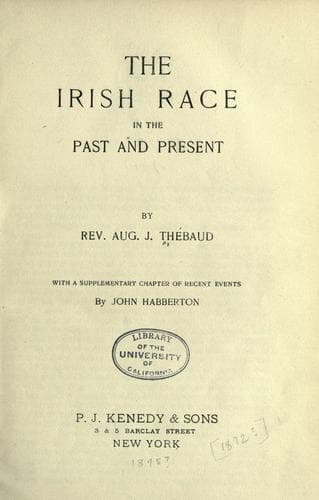
The Irish Race in the Past and the PresentThébaud, Augustus J.
History
The Irish Race in the Past and the Present
Thébaud, Augustus J.
Ireland -- History
A glance shows us the importance of the almost unanimous outcry
of the clansmen of Tyrone, Tyrconnell, and of other parts of
Ireland. Owing to the patriotic feeling of these, nothing
remained for the English but to punish the Irish people for
their resolve of holding to their religion, and to declare a
religious war against them, though they called them all the time
rebels and traitors. This is the view an impartial historian
should take of those mighty events.
But, it is well to look more closely at this new element, which
then showed itself for the first time in Irish national life,
the people, irrespective of clanship; the people, as influencing
the leaders, and thus becoming a living--nay, a ruling power in
the state. And, lest any of our readers should not be convinced
that such really was the case, we mention here a fact, which
will come more prominently before us in the next chapter, that,
at the end of Elizabeth's reign, the efforts of all her large
armies and her tortuous policy for changing the religion of the
country, resulted in the grand total of sixty converts to
Protestantism from the noble class, not one of the clansmen
turning apostate!
Bridget of Kildare would not have been surprised at this, to
judge by what we have previously heard from her.
In order to find the explanation of this wonderful fact, we must
compare the Irish people with other nationalities, and we may
then easily distinguish its peculiar features, so persistent, so
enduring, we may say, indestructible. We shall find that what
this people was three hundred years ago, it is to this day, with
a greater unity of feeling, devotedness to principle, and higher
aims than any people of modern times.
In antiquity, the people, in the Christian sense of the word,
never appeared in the field of history. In the despotic
countries of Asia and Africa, there was and could be no question
of such a thing; it was an inert mass used at will by the despot.
The Phoenician states, and Carthage in particular, were mere
oligarchies, with commerce for their chief object, and slaves
for mercantile or warlike purposes. In the republics of Greece
and Italy, the aristocracy ruled, and when, after centuries of
bloody struggles and revolutions, the subjects of Rome were
finally granted the rights of citizenship, the despotism of the
empire suddenly appeared, crushing both plebs and patricians.
Public-domain text, read in full here on John Shaqi.
Reviews
Reviews
No reviews yet
Be the first to share your thoughts on this work.
Elsewhere in the archive
Join the Discussion
Join the discussion
Sign in to leave a comment or review.
Sign InorCreate an account