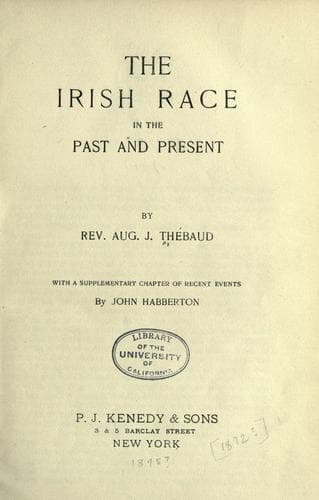
The Irish Race in the Past and the PresentThébaud, Augustus J.
History
The Irish Race in the Past and the Present
Thébaud, Augustus J.
Ireland -- History
Then, for the first time, did Ireland become a reality to them,
an existing personality, a desolate queen weeping over the fate
of her children, calling, with the voice of a stricken mother,
those who survived to her aid, and worthy, by her beauty and
misfortunes, of their most heroic and disinterested efforts.
Religious feeling, then, first made the Irish a nation, and gave
them that unity of thought which they now exhibit everywhere,
even in the remotest quarters of the globe, wherever they may
choose their place of exile. And if there still exists among
them something of that former predilection for the place where
they first saw the light, the other parts of Erin are at least
included in their deep love, and they would shed their blood for
their country, irrespective of prejudice of place.
Thus have they come at last to love each other as men of no
other nation ever did. In order to understand this thoroughly,
we must remember that for ages they, as a people, have been
oppressed and held in bondage by a stern and powerful nation.
They had to defend themselves in turn against the most open and
the most insidious attacks. Bereft in many cases of all the
means of defence, they had nothing left them, save their
religion, and the support they could afford each other.
If, by any stretch of imagination, we could place ourselves in
their position, understand their language when they met each
other in their huts, in their morasses and bogs, in their
mountain fastnesses and desolate moors, could we only enter into
their feelings and see the working of their minds, we might
catch a faint conception of the affection which they must have
felt for brothers waging the deadly fight against the same
enemies, and contending in a seemingly endless and hopeless
struggle against the same terrible odds. Union, affection,
devotedness, are words too weak to serve here.
For this reason, also, do we find the Irish people stamped with
peculiarities which we find in no others. In antiquity, as we
have said, the people could never rise to any thing greater than
a mob; in modern times such has also often been the case. With
the Irish it is not, and could not be so. Their aim has always
been too lofty, their struggle of too long duration, their
morality too genuine and too pure. For their aim has constantly
been to rescue their country; their struggle has lasted nearly
three hundred years; their morality has ever been directed by
the sweetest religion. Extreme cases of oppression such as
theirs may have occasionally given rise to violent outbreaks
inevitable in human despair; but, on the whole, it may to their
honor be fearlessly said, that they have preserved, almost
throughout, a due regard for social hierarchy and all kinds of
rights. Many of them have died of hunger, rather than touch the
property of a rich and hostile neighbor. Where else can we find
such an example?
Public-domain text, read in full here on John Shaqi.
Reviews
Reviews
No reviews yet
Be the first to share your thoughts on this work.
Elsewhere in the archive
Join the Discussion
Join the discussion
Sign in to leave a comment or review.
Sign InorCreate an account