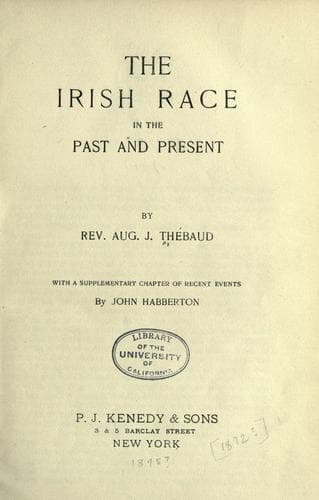
The Irish Race in the Past and the PresentThébaud, Augustus J.
History
The Irish Race in the Past and the Present
Thébaud, Augustus J.
Ireland -- History
This union of the people, which was thus brought about by
religious persecution, included not only the natives of the old
race, but the Anglo-Irish themselves, who were brought by
degrees to a unanimity of feeling which they had never known
before, although they had previously adopted Irish manners - a
unanimity which the Lutheran Archbishop Browne had foreseen and
openly denounced beforehand. This was the man who had
unwittingly borne testimony to the Irish that "the common people
of this isle are more zealous in their blindness than the saints
and martyrs were in the truth at the beginning of the Gospel;"
the same George Browne, of Dublin, had also been the first to
perceive that the religious question was beginning, even under
Henry VIII., to unite the native Irish and the descendants of
Strongbow's followers, until that time bitterly opposed to each
other.
In a letter, dated "Dublin, May, 1538," to the Lord Privy Seal,
he said: "It is observed that, ever since his Highness's
ancestors had this nation in possession, the old natives have
been craving foreign powers to assist and raise them; and now
both English race and Irish begin to oppose your lordship's
orders" (about supremacy), "and do lay aside their national old
quarrels, which, I fear, if any thing will cause a foreigner to
invade this nation, that will."
This man, who was altogether worldly and without faith,
displayed in this a keen political foresight far above that of
the ordinary counsellors of England's king. He openly announced
what actually came to pass only toward the middle of Elizabeth's
reign, and what the horrors of the Cromwellian wars were to
complete - the thorough fusion of Irish and Anglo-Norman
Catholics, both transplanted to Connaught, perishing under the
sword of the soldier, the rope of the hangman, or dying of
starvation in the recesses of their mountains - united forever
in the bonds of martyrdom.
The "birth of the Irish people" was to be insured by another
measure of the English Government - the suppression of religious
houses. We must, in conclusion, turn to this.
In the annals of the Four Masters, under the year 1537, we read:
"A heresy and a new error broke out in England, the effect of
pride, vainglory, avarice, sensual desire, and the prevalence of
a variety of scientific and philosophical speculations, so that
the people of England went into opposition to the Pope and to
Rome.
"At the same time, they followed a variety of opinions; and,
adopting the old law of Moses, after the manner of the Jewish
people, they gave the title of Head of the Church of God, during
his reign, to the king. They ruined the orders who were
permitted to hold worldly possessions, namely, monks, canons
regular, nuns, and Brethren of the Cross, etc . . . . They broke
into the monasteries, they sold their roofs and bells; so that
there was not a monastery from Arran of the Saints to the Iccian
Sea that was not broken and scattered, except only a few in
Ireland."
Public-domain text, read in full here on John Shaqi.
Reviews
Reviews
No reviews yet
Be the first to share your thoughts on this work.
Elsewhere in the archive
Join the Discussion
Join the discussion
Sign in to leave a comment or review.
Sign InorCreate an account