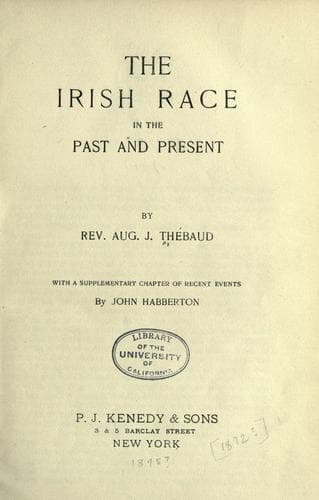
The Irish Race in the Past and the PresentThébaud, Augustus J.
History
The Irish Race in the Past and the Present
Thébaud, Augustus J.
Ireland -- History
This variety is visible to us chiefly on our globe; in the infinite
multiplicity of its animal forms, in the wonderful insect tribes,
and in the brilliant shells floating in the ocean; visible also
in the incredible number of trees, shrubs, herbs, down to the most
minute vegetable organisms, spread with such reckless abundance
on the surface of our dwelling; visible, finally, in the infinity
of different shapes assumed by inorganic matter.
But what is yet more wonderful and seemingly unaccountable is that,
taking every species of being in particular, and looking at any two
individuals of the same species, we would consider it an astonishing
effect of chance, were we to meet with two objects of our study
perfectly alike. The mineralogist notices it, if he finds in the same
group of crystals two altogether similar; the botanist would express
his astonishment if, on comparing two specimens of the same plant,
he found no difference between them. The same may be said of birds,
of reptiles, of mammalia, of the same kind. A close observer will
even easily detect dissimilarities between the double organs of the
same person, between the two eyes of his neighbor, the two hands
of a friend, the two feet of a stranger whom he meets.
It is therefore but consistent with general analogy that in the moral
as well as in the physical faculties of man, the same ever-recurring
variety should appear, in the features of the face, in the shape of
the limbs, in the moving of the muscles, as well as in the activity
of thought, in the mobility of humor, in the combination of passions,
propensities, sympathies, and aversions.
But, at the same time, with all these peculiarities perceptible in
individuals, men, when studied attentively, show themselves in
groups, as it were, distinguished from other groups by peculiarities
of their own, which are generally called characteristics of race;
and although, according to various systems, these characteristics
are made to expand or contract at will, to serve an _a priori_
purpose, and sustain a preconcerted theory, yet there are, with
respect to them, startling facts which no one can gainsay, and
which are worthy of serious attention.
Two of these facts may be stated in the following propositions:
I. At the cradle of a race or nation there must have been a type
imprinted on its progenitor, and passing from him to all his
posterity, which distinguishes it from all others.
II. The character of a race once established, cannot be eradicated
without an almost total disappearance of the people.
Public-domain text, read in full here on John Shaqi.
Reviews
Reviews
No reviews yet
Be the first to share your thoughts on this work.
Join the Discussion
Join the discussion
Sign in to leave a comment or review.
Sign InorCreate an account