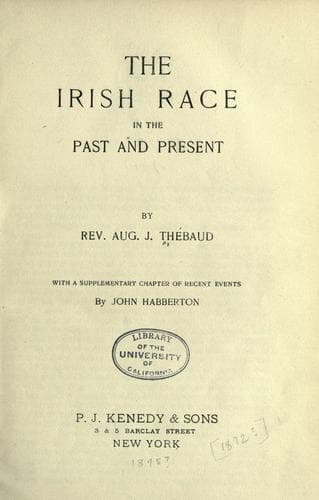
The Irish Race in the Past and the PresentThébaud, Augustus J.
History
The Irish Race in the Past and the Present
Thébaud, Augustus J.
Ireland -- History
The proofs of these propositions would require long details altogether
foreign to our present purpose, as we are not writing on ethnology.
We will take them for granted, as otherwise we may say that the
whole history of man would be unintelligible. If, however, writers
are found who apply to their notion of race all the inflexibility
of physical laws, and who represent history as a rigid system of
facts chained together by a kind of fatality; if a school has
sprung up among historians to do away with the moral responsibility
of individuals and of nations, it is scarcely necessary to tell
the reader that nothing is so far from our mind as to adopt ideas
destructive, in fact, to all morality.
It is our belief that there is no more "necessity" in the leanings
of race with respect to nations, than there is in the corrupt
instincts of our fallen nature with respect to individuals. The
teachings of faith have clearly decided this in the latter case,
and the consequence of this authoritative decision carries with
it the determination of the former.
According to the doctrine of St. Augustine, nations are rewarded
or punished in this world, because there is no future existence
for them; but the fact of rewards and punishments awarded them
shows that their life is not a series of necessary sequences such
as prevail in physics, and that the manifestations or phenomena
of history, past, present, or future, cannot resolve themselves
into the workings of absolute laws.
Race, in our opinion, is only one of those mysterious forces which
play upon the individual from the cradle to the grave, which affect
alike all the members of the same family, and give it a peculiarity
of its own, without, however, interfering in the least with the moral
freedom of the individual; and as in him there is free-will, so also
in the family itself to which he belongs may God find cause for
approval or disapproval. The heart of a Christian ought to be too
full of gratitude and respect for Divine Providence to take any
other view of history.
It would be presumptuous on our part to attempt an explanation of
the object God proposed to himself in originating such a diversity
in human society. We can only say that it appears He did not wish
all mankind to be ever subject to the same rule, the same government
and institutions. His Church alone was to bear the character of
universality. Outside of her, variety was to be the rule in human
affairs as in all things else. A universal despotism was never
to become possible.
This at once explains why the posterity of Japhet is so different
from that of Sem and of Cham.
Public-domain text, read in full here on John Shaqi.
Reviews
Reviews
No reviews yet
Be the first to share your thoughts on this work.
Join the Discussion
Join the discussion
Sign in to leave a comment or review.
Sign InorCreate an account