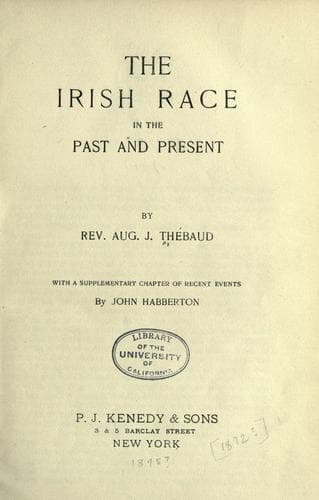
The Irish Race in the Past and the PresentThébaud, Augustus J.
History
The Irish Race in the Past and the Present
Thébaud, Augustus J.
Ireland -- History
We attribute this "birth of a nation" to Henry VIII., because
the change which he tried to introduce into the religion of the
island constituted the occasion and origin of it; and, although
his reign never witnessed that perfect union of the people which
came later on, nevertheless, it is true that then it surely
began, and its origin was the attempt to establish his spiritual
supremacy in Ireland.
This feeling of union and strength in love went on growing, and
showed itself more and more, wring the two centuries which
followed, when so many scenes similar to the one described were
enacted in the remotest parts of the island. God, in his mercy,
provided it with many high mountains, difficult of access, whose
paths were known only to the natives. In these fastnesses, the
holy men, who had been driven from their dwellings and their
churches, could rest in peace and attend to the duties of their
office. They could even recruit their shattered forces, admit
novices, and train them up; and thus their rule continued to be
observed, and their existence as a body protracted, long after
their enemies imagined that they had perished utterly. As soon
as quiet was restored, when persecution abated, and breathing-
time was given them, so that they could show themselves, with
some safety, more openly, they visited their old abodes, often
found some portions of the ruins which admitted of repair, and
dwelt again in security where their predecessors had dwelt for
centuries.
The peasant's hut would also often afford them shelter; some
solitary farm-house on the borders of a lake, or near a deep
morass, took the name of their monastery; some cranogue in the
lake, or dry spot in the thick of the morass, which they could
reach by paths known to themselves only, was their asylum in
times of extraordinary danger. In ordinary times, the farm-house,
to which they had given the name of their lost monastery, was
their convent. It was thus the brothers O'Cleary, and their
companions, lived for years, editing the work of the "Four
Masters," until, at length, they succeeded in publishing their
extraordinary "Annals." The manuscripts which, in spite of the
raging persecution, and the "penal laws," they traversed the
whole island to collect, were preserved, with a reverend care,
in a poor Irish hut. Literary treasures which have since
unfortunately perished, but which they saved for a time from the
reach of the enemy, and which they perpetuated by having them
printed, filled the poor presses and the old furniture of their
asylum, and, owing purely to the friendly help of those who had
given them shelter, they were enabled to enrich the world with
their marvellous compilation.
Public-domain text, read in full here on John Shaqi.
Reviews
Reviews
No reviews yet
Be the first to share your thoughts on this work.
Elsewhere in the archive
Join the Discussion
Join the discussion
Sign in to leave a comment or review.
Sign InorCreate an account