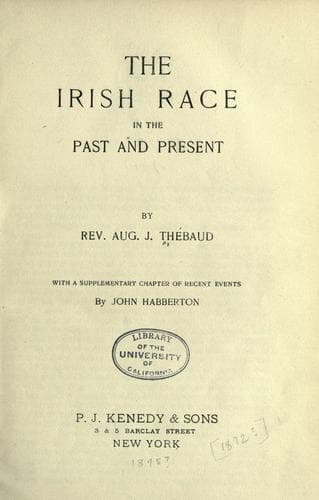
The Irish Race in the Past and the PresentThébaud, Augustus J.
History
The Irish Race in the Past and the Present
Thébaud, Augustus J.
Ireland -- History
From the mountain and the hut, on the river-side, the monks were
sometimes allowed to move to their former dwellings, at the risk,
nevertheless, of their liberty and lives. What their ancestors
had done during the Scandinavian invasions, when the monasteries
were so often destroyed and rebuilt, that did the monks of the
sixteenth and seventeenth centuries likewise in many parts of
the island.
Thus, Father Mooney, a Franciscan, relates that his monastery -
that of Multifarnham - having been totally destroyed by Sir
Francis Shean, and many monks having been killed, he, with a few
others, after long and extraordinary adventures, came back to
the spot, then abandoned by the enemy, and "before the feast of
the Nativity of our Lord, we built up a little house on the site
of the monastery, and there we dwelt who were left after the
flight . . . . . Afterward, Father Nehemias Gregan, the father
guardian, began to build a church, and to repair the monastery,
and for this purpose caused much wood to be cut in the territory
of Deabhna McLochlain; and when they had roofed a chapel and
some other buildings, there came the soldiers of another Sir
Francis Ringtia, and they burned down the monastery again, and
carried off some of the brethren captive to Dublin."
This convent of Multifarnham was raised a third time; and, in
fact, remained in possession of the Franciscans throughout the
persecution, so that to this day the old church has been restored
by them, and the modern house, which now forms their convent,
is built on the site of the old monastery.
Such for a long time was the case with many other religious
establishments; for the same Father Mooney, writing as late as
1624, says: "When Queen Elizabeth strove to make all Ireland
fall away from the Catholic faith, and a law was passed
proscribing all the members of the religious orders, and giving
their monasteries and possessions to the treasury, while all the
others took to flight, or at least quitted their houses, and,
for safety's sake, lived privately and singly among their
friends, and receiving no novices, the order of St. Francis
alone ever remained, as it were, unshaken. For, though they were
violently driven out of some convents to the great towns, and
the convents were profanely turned into dwellings for seculars,
and some of the fathers suffered violence, and even death; yet,
in the country and other remote places, they ever remained in
the convents, celebrating the divine office according to the
custom of religious, their preachers preaching to the people and
performing their other functions, training up novices and
preserving the conventual buildings, holding it sinful to lay
aside, or even hide, their religious habit, though for an hour,
through any human fear. And, every three years, they held their
regular provincial chapters in the woods of the neighborhood,
and observed the rule as it is kept in provinces that are in
peace."
Public-domain text, read in full here on John Shaqi.
Reviews
Reviews
No reviews yet
Be the first to share your thoughts on this work.
Elsewhere in the archive
Join the Discussion
Join the discussion
Sign in to leave a comment or review.
Sign InorCreate an account