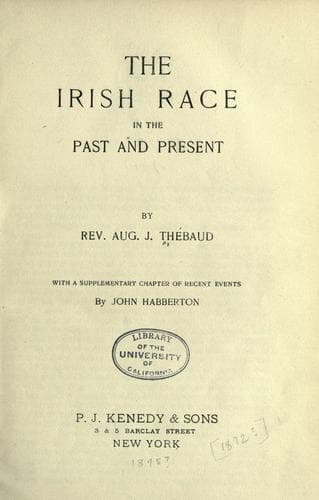
The Irish Race in the Past and the PresentThébaud, Augustus J.
History
The Irish Race in the Past and the Present
Thébaud, Augustus J.
Ireland -- History
Thus, when the Cromwellian persecution began, the religious
orders were again flourishing in Ireland. They had obtained from
the Stuarts some relaxation in the execution of the laws, and,
as all at the time were fighting for Charles I. against the
Parliamentarians, it was only natural that the authorities did
not carry out the barbarous laws to their full extent in the
island.
It is no matter of great surprise, therefore, that, in 1641,
more than one hundred years after the decree of Henry VIII., the
Franciscan order still possessed sixty-two flourishing houses in
Ireland, each with a numerous community, besides ten convents of
nuns of the order of St. Clare. The acts of the General Chapter
of the Dominicans, held in Rome in 1656, referring to the same
persecution of Cromwell, state that, when it began, there were
forty-three convents of the order, containing about six hundred
inmates, of whom only one-fourth survived the calamity. The
Jesuits were eighty in number, in 1641, of whom only seventeen
remained when the storm had passed away. From a petition
presented to the Sacred Congregation, in 1654, we learn that all
the Capuchins had been banished, except a few who remained on
the island, where they lived as "shepherds," "herdsmen," or
"tillers of the soil."
All the decrees of the Parliaments of Henry VIII. and Elizabeth
had not succeeded, in the space of a century, in destroying
monasticism; the Cromwellian war alone seemed to have done so,
as it left the entire nation almost at the last gasp, on the
verge of annihilation. Nevertheless, a few years saw the orders
again revive and prepare to start their holy work anew. Henry
VIII. then, and his vicar, Cromwell, deceived themselves in
thinking that they had put an end to monasticism in the land
which had been the cradle of so many families of religious. They
succeeded only in intensifying the determination of Irishmen not
to allow their nationality to be absorbed in that of England. If
any thing was calculated to nourish and keep alive that
sentiment in their hearts, it was their daily communing with the
holy men who shared their distress, their mountain-retreats,
their poverty in the bogs, their wretchedness in the woods and
glens. If monasticism had created and nurtured the nation on its
first becoming Christian, it gave to the people a second birth
holier than the first, because consecrated by martyrdom.
Henceforth, divided clans and antagonistic septs were to be
unknown among them: only Catholic Irishmen were to remain ranked
around the successors of "the saints" of old, all determined to
be what they were, or die. But as laws, edicts, and measures of
fanatic frenzy cannot destroy a nation, the new people was
destined to survive for better and brighter days.
Public-domain text, read in full here on John Shaqi.
Reviews
Reviews
No reviews yet
Be the first to share your thoughts on this work.
Elsewhere in the archive
Join the Discussion
Join the discussion
Sign in to leave a comment or review.
Sign InorCreate an account