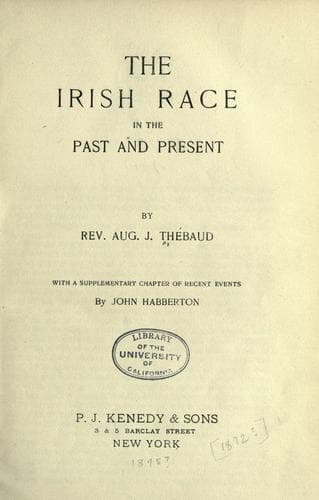
The Irish Race in the Past and the PresentThébaud, Augustus J.
History
The Irish Race in the Past and the Present
Thébaud, Augustus J.
Ireland -- History
We have anticipated the course of events somewhat, in order to
pass in review the chief facts connected with the designs of the
English Government upon the religious orders. These few words
will suffice to give the reader an idea of the new character
which such events impressed upon the Irish nation. Every day saw
it more compact; every day the resolve to fight to the death for
God's cause, grew stronger; the old occasions of division grew
less and less, and that unanimity, which suffering for a noble
cause naturally gives rise to in the human heart, showed itself
more and more. A nation, in truth, was being born in the throes
of a wide-spread and long-continued calamity; but long ages were
in store in times to come to reward it for the misfortunes of
the past.
It is a remarkable thing that, when England, through fear of
civil war, was compelled to grant Catholic emancipation in 1829,
when Irish agitators succeeded in wrenching it from the enemy,
and obtaining it, not only for themselves, but likewise for
their English Catholic brethren, the British statesmen, who
finally consented to such a tardy measure of justice, steadily
refused, nevertheless, to extend the boon to the religious
orders. These remained under the ban, and so they remain still.
The "penal laws" were never repealed for them, and, even to this
day, they are, according to law, strictly prohibited from
"receiving novices" under all the barbarous penalties formerly
enacted and never abrogated.
But the nation has constantly considered this exception as not
to be taken into account. The religious orders now existing are
under the protection of the people, and England has never dared
to use even a threat against the open violation of these "laws."
Dr. Madden, in his interesting work on "Penal Laws," gives
prominence to this fact by warmly taking up the old theme of
thorough-going Irish Catholicity, by asserting, with force, that
"religious orders are necessary to the Church," and that to deny
their right to exist, even though it be only on paper in the
statute-book, is none the less an outrage against so thoroughly
Catholic a nation as the Irish.
The only fact which appears to clash with our reflections is the
one well ascertained and mentioned by us, that some native Irish
lords occupied certain monasteries and took their share in the
sacrilegious plunder. But a few chieftains cannot be said to
constitute the nation, and doubtless many of those who yielded
to the temptation, listened later to the reproving voice of
their conscience, as in the following case, given by Miles
O'Reilly, in his "Irish Martyrs:"
Public-domain text, read in full here on John Shaqi.
Reviews
Reviews
No reviews yet
Be the first to share your thoughts on this work.
Elsewhere in the archive
Join the Discussion
Join the discussion
Sign in to leave a comment or review.
Sign InorCreate an account