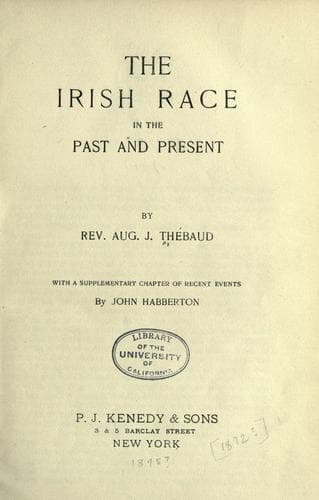
The Irish Race in the Past and the PresentThébaud, Augustus J.
History
The Irish Race in the Past and the Present
Thébaud, Augustus J.
Ireland -- History
"Gelasius O'Cullenan, born of a noble family in Connaught . . .
joined the Cistercian order. Having competed his studies in
Paris, the monastery of Boyle was destined as the field of his
labors. On his arrival in Ireland, he found that the monastery,
with its property, had been seized on by one of the neighboring
gentry, who was sheltered in his usurpation by the edict of
Elizabeth. The abbot . . . went boldly to the usurping nobleman,
admonishing him of the guilt he had incurred; and the
malediction of Heaven, which he would assuredly draw down upon
his family. Moved by his exhortations, the nobleman restored to
him the full possession of the monastery and lands; and, some
time after, contemplating the holy life of its inmates, . . . he,
too, renounced the world and joined the religious institute."
CHAPTER IX.
THE IRISH AND THE TUDORS.--ELIZABETH.--THE UNDAUNTED NOBILITY.--
THE SUFFERING CHURCH.
On January 12, 1559, in the second year of the reign of
Elizabeth, a Parliament was convened in Dublin to pass the Act
of Supremacy; that is to say, to establish Lutheranism in
Ireland, as had already been done in England, under the garb of
Episcopalianism.
But the attempt was fated to encounter a more determined
opposition in Dublin than it had in London.
Sir James Ware says, in reference to it: "At the very beginning
of this Parliament, her Majestie's well-wishers found that most
of the nobility and Commons--they were all English by blood or
birth--were divided in opinion about the ecclesiastical
government, which caused the Earl of Sussex (Lord Deputy) to
dissolve them, and to go over to England to confer with her
Majesty about the affairs of this kingdom.
"These differences were occasioned by the several alterations
which had happened in ecclesiastical matters within the compass
of twelve years.
"1. King Henry VIII. held the ecclesiastical supremacy with the
first-fruits and tenths, maintaining the seven sacraments, with
obits and mass for the living and the dead.
"2. King Edward abolished the mass, authorizing the book of
common prayers, and the consecration of the bread and wine in
the English tongue, and establishing only two sacraments.
"3. Queen Mary, after King Edward's decease, brought all back
again to the Church of Rome, and the papal obedience.
"4. Queen Elizabeth, on her first Parliament in England, took
away the Pope's supremacy, reserving the tenths and first-fruits
to her heirs and successors. She put down the mass, and, for a
general uniformity of worship in her dominions, as well in
England as in Ireland, she established the book of common
prayers, and forbade the use of popish ceremonies."
Such is the very lucid sketch furnished by Ware of the changes
which had taken place in religion in England within the brief
space of twelve years.
Public-domain text, read in full here on John Shaqi.
Reviews
Reviews
No reviews yet
Be the first to share your thoughts on this work.
Elsewhere in the archive
Join the Discussion
Join the discussion
Sign in to leave a comment or review.
Sign InorCreate an account