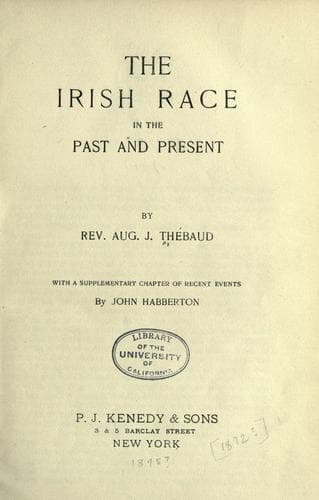
The Irish Race in the Past and the PresentThébaud, Augustus J.
History
The Irish Race in the Past and the Present
Thébaud, Augustus J.
Ireland -- History
The rash or, perhaps, treacherous share taken by a few Irish
chieftains, in the schismatical and heretical as well as
unpatriotic decrees of the Parliament of 1541, and in the
subsequent ones of 1549, could compromise the Irish nation in
nowise, inasmuch as the people, being still even in legal
enjoyment of their own government, their chieftains possessed no
authority to decide on such questions without the full
concurrence of their clans, and these had already pronounced,
clearly enough and unmistakably, on the return of their lords
from their title-hunting expedition in England.
All the chroniclers of the time agree that "the people" was
invariably sound in faith, siding with the chieftains wherever
they rose in opposition to oppressive decrees, abandoning them
when they showed signs of wavering, even; but, above all, when
they ranged themselves with the oppressors of the Church. The
English Protestant writers of the period confirm this honorable
testimony of the Irish bards, by constantly accusing the natives
of a "rebellious" spirit.
The history of the Geraldine struggle is known to all readers of
Irish history, and does not enter into the scope of these pages.
We have, however, to consider the foreign aid which the
chieftains received, from Spain chiefly, and the causes of these
failures, which at first would seem to argue a lack of firmness
on the part of the Irish themselves. During the Geraldine wars,
and later on in what is called the rebellion of Hugh O'Neill and
Hugh O'Donnell, the King of Spain sent vessels and troops to the
assistance of the Irish. All these expeditions failed, and the
destruction of the natives was far greater than it might
otherwise have been, in consequence of the greater number of
English troops sent to Ireland to face the expected Spanish
invasion.
The same ill success attended the French fleet and army
dispatched to Limerick by Louis XIV. to assist James II., and,
later still, the large fleet and well-appointed troops sent by
the French Convention to the aid of the "United Irishmen," in
1798.
In like manner, the Vendeans, on the other side, those French
"rebels" against the Convention itself, received their death-
blow in consequence of the English who were sent to their succor
at Quiberon.
It seems, indeed, a universal historic law that, when a nation
or a party in a nation struggles against another, the almost
invariable consequence of foreign aid is failure; but no
conclusion can be deduced from that fact of lack of bravery,
steadfastness, even ultimate success, on the part of those who
rise in arms against oppression. Of the many causes which may be
assigned to that apparently strange law of history, the chief
are:
Public-domain text, read in full here on John Shaqi.
Reviews
Reviews
No reviews yet
Be the first to share your thoughts on this work.
Elsewhere in the archive
Join the Discussion
Join the discussion
Sign in to leave a comment or review.
Sign InorCreate an account