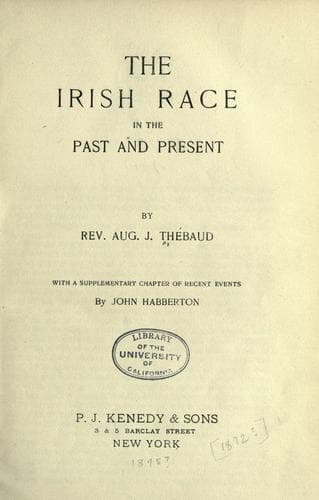
The Irish Race in the Past and the PresentThébaud, Augustus J.
History
The Irish Race in the Past and the Present
Thébaud, Augustus J.
Ireland -- History
Sir James Ware is bold enough to say that, in all her dealings
with the Irish nobility, Elizabeth never mentioned religion, and
their right of practising it as they wished never came into the
question. She certainly never subjected them to any oath, as was
the case in England. Technically speaking, this statement seems
correct. Yet it is undeniable that Elizabeth allowed no Catholic
bishops or priests to remain in the island; permitted the Irish
to have none but Protestant school-teachers for their children;
bestowed all their churches on heretical ministers; closed, one
by one, all the buildings which Catholics used for their worship,
as soon as their existence became known to the police; in fact
obliged them to practise Protestantism or no religion at all.
In the eyes of Elizabeth a Catholic was a "rebel." Whoever was
executed for religion during her reign was executed for
"rebellion." The Roman emperors who persecuted the Church during
the first three centuries, might have advanced the same
pretences And indeed the early Christians were said to be
tortured and executed for their "violation of the laws of the
empire."
This point will come more clearly before us in considering the
second phase of the policy of Elizabeth, her direct interference
with the Church.
II. If the policy of England's queen had been one of treachery
and deceit toward the nobility, toward the Church it was
avowedly one of blood and destruction.
Well-intentioned and otherwise well-informed writers, among them
Mr. Prendergast, seem to consider that the main object of the
atrocious proceedings we now proceed to glance at was "greed,"
and that the English Government merely connived at the covetous
desires of adventurers and undertakers, who wished to destroy
the Irish and occupy their lands; for, as Spenser says "Sure it
was a most beautiful and sweete country as any under heaven,
being stored throughout with many goodly rivers, replenished
with all sorts of fish most abundantly; sprinkled with many very
sweete islands, and goodly lakes like little inland seas;
adorned with goodly woods; also full of very good ports and
havens opening upon England as inviting us to come into them."
Such, according to those writers, was the policy of England from
the first landing of Strongbow on the shores of Erin, and even
during the preceding four centuries, when both races were
Catholic, and the conversion of the natives to Protestantism
could not enter the thoughts of the invaders.
This, to a certain extent, is true. Still, it seems very
doubtful to us that Elizabeth should have undertaken so many
wars in Ireland, which lasted through her whole reign, and on
which she employed all the strength and resources of England,
merely to please a certain number of nobles who wished to find
foreign estates whereon to settle their numerous offspring.
Public-domain text, read in full here on John Shaqi.
Reviews
Reviews
No reviews yet
Be the first to share your thoughts on this work.
Elsewhere in the archive
Join the Discussion
Join the discussion
Sign in to leave a comment or review.
Sign InorCreate an account