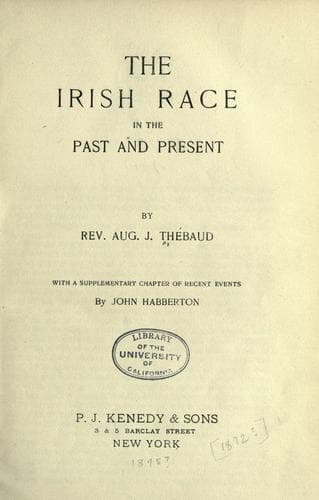
The Irish Race in the Past and the PresentThébaud, Augustus J.
History
The Irish Race in the Past and the Present
Thébaud, Augustus J.
Ireland -- History
The chief importance, in her eyes, of the conquest was clearly
to establish her spiritual superiority in that part of her
dominions. She would have left the native nobles at peace, and
even conferred on them her choicest favors, had they only
consented, as English subjects, to break with Rome. Rome had
excommunicated her; Pius V. had released her subjects from their
allegiance because of her heresy, and Ireland did not reject the
bull of the Pope. This in her eyes constituted the great and
unpardonable offence of the Irish. And that, for her, the whole
question bore a religious character, will appear more clearly
from her conduct toward the Catholic Church throughout her reign.
Into this part of our subject the examination of the step taken
by Pius V. naturally enters, and, in examining it, we shall see
whether, and how far, the Irish can be called rebels and
"traitors."
In his history of the Reformation, Dr. Heylin says of Elizae's
supremacy could not stand together, and she could not possibly
maintain the one without discarding the other." This is
perfectly true, and furnishes us with the key to all her church
measures.
She pretended to be a Catholic during Mary's reign; but it was
merely pretence. To persevere in Catholicity required of her the
sacrifice of her political aspirations; for the Church could not
admit of her legitimacy, and consequently her title to the crown
of England. Hence, upon the death of Mary Tudor, the Queen of
Scots immediately assumed the title of Queen of England; and
although the Pope, then Pius IV., did not immediately declare
himself in favor of Mary Stuart, but reserved his decision for a
future period, nevertheless, the view of the case adopted by the
Pontiff could not be mistaken. Elizabeth's legitimacy, or, as
Heylin has it, "legitimation and the Pope's supremacy could not
stand together." No course was left open to her, then, than to
reject the pontifical authority, and establish her own in her
dominions, as she did not possess faith enough to set her soul
above a crown; and the success of her father, Henry VIII., and
of her half-brother, Edward VI., encouraged her in this step.
This fully explains her policy. It became a principle with her
that, to accept the Pope's supremacy in spirituals, was to deny
her legitimacy, and consequently to be guilty of treason against
her. This made the position of Catholics in England and Ireland
a most trying one. But their moral duty was clear enough, and
every other obligation had to give way before that. In the
persecution which followed they were certainly martyrs to their
duty and their religion.
Public-domain text, read in full here on John Shaqi.
Reviews
Reviews
No reviews yet
Be the first to share your thoughts on this work.
Elsewhere in the archive
Join the Discussion
Join the discussion
Sign in to leave a comment or review.
Sign InorCreate an account