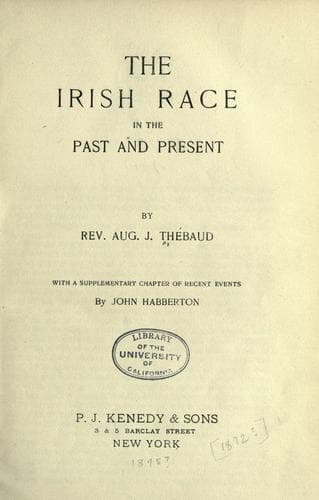
The Irish Race in the Past and the PresentThébaud, Augustus J.
History
The Irish Race in the Past and the Present
Thébaud, Augustus J.
Ireland -- History
That the question of the succession in England was an open one,
must be admitted by every candid man. Who was the legitimate
Queen of England at the death of Mary Tudor? The Queen of Scots
assumed the title, and, as the legitimate offspring of the
sister of Henry VIII., she had the right to it as the nearest
direct descendant in the event of Elizabeth's pretensions not
being admitted by the nation. The nation at the time was in fact,
though not in right, the nobles, who enriched themselves at the
expense of the Church, and were therefore deeply interested in
the exclusion of Catholic principles. A Parliament composed of
the nobles had already acknowledged Elizabeth to the exclusion
of the Queen of Scots, and the former decision was reaffirmed as
against a "female pretender" supported by a foreign power,
namely, France.
England, that is to say, the corrupt nobility of the kingdom, by
taking upon itself that decision, refused to submit the question
to the arbitration of the Pope; and thus, for the first time,
the principles which had guided Christendom for eight hundred
years, were discarded. Yet, under Mary, the Catholic Church had
been declared the Church of the state; at her death, no change
took place; the mass of the people was still Catholic. It took
Elizabeth her whole reign to make the English a thoroughly
Protestant people. The great mass of the nation came
consequently then, even legally, under the law of mediaeval
times, which surrendered the decision of such cases into the
hands of the Roman Pontiff.
Again, when we reflect that our preset object is the
consideration of who was the legitimate Queen of Ireland, the
question becomes clearer and simpler still. The supremacy of
Henry VIII. had never been acknowledged in the island, even by
those who had subscribed to the decrees of the Parliament of
1541 and 1569. The Irish chieftains had not only never assented,
but had always preserved their independence in all, save the
suzerainty of the English monarchs, and they were at the time,
without exception, Catholics. For them, therefore, the Pope was
the expounder of the law of succession to the throne, as, up to
that time, he had been generally recognized in Europe. Elizabeth,
consequently, as an acknowledged illegitimate child, could not
become a legitimate queen without a positive declaration and
election by the true representatives of the people, approved by
the Pope. Her assumption, then, of the supreme government was a
mere usurpation. The theory of governments de facto being obeyed
as quasi-legitimate had not yet been mooted among lawyers and
theologians. With respect to the whole question, there can be no
doubt as to the conclusion at which any able constitutional
jurist of our days would arrive.
Public-domain text, read in full here on John Shaqi.
Reviews
Reviews
No reviews yet
Be the first to share your thoughts on this work.
Elsewhere in the archive
Join the Discussion
Join the discussion
Sign in to leave a comment or review.
Sign InorCreate an account