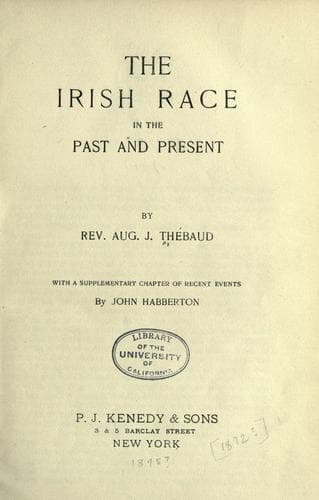
The Irish Race in the Past and the PresentThébaud, Augustus J.
History
The Irish Race in the Past and the Present
Thébaud, Augustus J.
Ireland -- History
Could usurped rights such as these invest Elizabeth with
authority to declare herself paramount not only in political but
also in religious matters? And, because she was called queen,
can it be considered treason for an Irishman to believe in the
spiritual supremacy of the Pope? Yet, unless we look upon as
martyrs those who died on the rack and the gibbet in Ireland
during her reign, because they refused to admit in a woman the
title of Vicar of Christ, to such decision must we come.
The policy of the English queen toward Catholic bishops, priests,
and monks, presents the question in a still stronger light. Its
chief feature will now come before us, and will show how all of
these suffered for Christ. We say all, because not only those
are included in the category who held aloof from politics and
confined themselves to the exercise of their spiritual functions,
but those also who, at the bidding of the Pope, or following
the natural promptings of their own inclinations, favored the so-
called rebellion of the Geraldine and of the Ulster chieftains.
The lives and death of both are now well known, and to both we
award the title of heroes and Christian martyrs.
As it would be too long to present here a complete picture of
those events, and trace the biography of many of those who
suffered persecution at that time, we content ourselves with two
faithful representatives of the classes above mentioned--Richard
Creagh, Archbishop of Armagh, and Dr. Hurley, Archbishop of
Cashel. The case of the great Oliver Plunkett, who suffered
under Charles II., and who was the victim of the entire English
nation, is beyond our present discussion.
The biography of the first of these has been written by several
authors, who, agreeing as to the main facts of his history,
differ only in their chronology. Dr. Roothe's account is the
longest of all and is intricate, and subject to some confusion
with regard to dates; but a sketch of that life, which appeared
in the Rambler of April, 1853, is the most consistent and easily
reconciled with the well-known facts of the general history of
the period, and therefore we follow it:
Richard Creagh, proposed for the See of Armagh by the nuncio,
David Wolfe, arrived at Limerick in the August of 1560, at the
very beginning of the reign of Elizabeth. Pius IV., who was then
Pontiff, had not come to any conclusion respecting the
sovereignty of England, and did not openly declare himself in
favor of the right of Mary Stuart to the crown. The Pope, not
having given any positive injunctions to Archbishop Creagh, with
regard to his political conduct, the latter was left free to
follow the dictates of his conscience. He came only with a
letter, to Shane O'Neill, who, at the time, was almost
independent in Ulster.
Public-domain text, read in full here on John Shaqi.
Reviews
Reviews
No reviews yet
Be the first to share your thoughts on this work.
Elsewhere in the archive
Join the Discussion
Join the discussion
Sign in to leave a comment or review.
Sign InorCreate an account