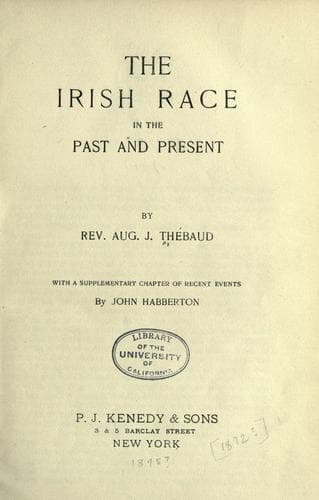
The Irish Race in the Past and the PresentThébaud, Augustus J.
History
The Irish Race in the Past and the Present
Thébaud, Augustus J.
Ireland -- History
Not only did the archbishop not take any part in the political
measures of the Ulster chieftain, who was often at war with
Elizabeth, but he soon came to a disagreement with him on purely
conscientious grounds, and finally excommunicated him. In the
midst of the many difficulties which surrounded him, he resolved
to inculcate peace and loyalty to Elizabeth throughout Ulster,
asking of Shane only one favor, that of founding colleges and
schools, and thinking that, by remaining loyal to the queen, he
might obtain her assistance in founding a university. The good
prelate little knew the character of the woman with whom he had
to deal, imagining probably that the decree of her spiritual
supremacy would remain a dead letter for the priesthood, as had
been falsely promised to the laity.
But he was not left long to indulge in these delusions; for, in
the act of celebrating mass in a monastery of his diocese, he
was betrayed by some informer, and was arrested by a troop of
soldiers, who conducted him before the government authorities,
by whom he was sent to London and confined in the Tower on
January 18,1565. He was there several times interrogated by
Cecil and the Recorder of London, who could easily ascertain
that the prelate was altogether guiltless of political intrigue.
He escaped miraculously, passed through Louvain, went to Spain,
at the time at peace with England, and, wishing to return to
Ireland, wrote, through the Spanish ambassador, to Leicester,
then all-powerful with the queen, to protest beforehand that, if
the Pope should order him to return to his diocese, he intended
only to render to Caesar what is Caesar's and to God what is
God's. Even then, after his prison experience of several months,
he thought that, if he could persuade Elizabeth that he was
truly loyal to her, she would forgive him his Catholicity.
Receiving no answer, he set sail for his country, where he
landed in August, 1566, and shortly after wrote to Sir Henry
Sidney, then lord-deputy, in the very terms he had used with
Leicester, and proposing in addition to use his efforts in
inducing Shane O'Neill to conclude peace.
What Sidney and his masters in London, Cecil and Leicester, must
have thought of the simplicity of this good man, it is
impossible to say. They condescended to return no answer to his
more than straightforward communication, save the short verbal
reply concerning O'Neill: "We have given forth speach of his
extermination by war."
The good prelate, after having so clearly defined his position,
thought he might safely follow the dictates of his conscience,
and govern his flock in peace; but he was soon taken prisoner,
in April, 1567, by O'Shaughnessy, who received a special letter
of thanks from Elizabeth for his services on this occasion.
Public-domain text, read in full here on John Shaqi.
Reviews
Reviews
No reviews yet
Be the first to share your thoughts on this work.
Elsewhere in the archive
Join the Discussion
Join the discussion
Sign in to leave a comment or review.
Sign InorCreate an account