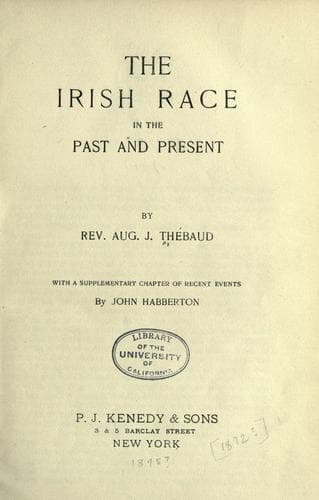
The Irish Race in the Past and the PresentThébaud, Augustus J.
History
The Irish Race in the Past and the Present
Thébaud, Augustus J.
Ireland -- History
Bv order of the queen, he was tried in Dublin; but, so clear was
the case before them, that even a Protestant jury could not
convict him. The honest Dublin jurors were therefore cast into
prison and heavily fined, while the prelate was once again
transferred to London, whence he a second time escaped by the
connivance of his jailor.
Retaken in 1567, he was handed over to the queen's officers,
under a pledge that his life would be spared. And, in
consequence of this pledge alone, was he never brought to trial,
but kept a close prisoner in the Tower for eighteen years, until
in 1585 he was, according to all reliable accounts, deliberately
poisoned.
This simple narrative certainly proves that in Elizabeth's eyes,
the mere sustaining the Pope's spiritual supremacy was treason,
and every Catholic consequently, because Catholic, a traitor
deserving death. True, the Irish prelates, monks, and people,
might have imitated the majority of the English nobles and
people in accepting the new dogma. In that case, they would have
become truly loyal and dutiful subjects, and been admitted to
all the rights of citizenship; the nobles would have retained
possession of their estates, the gentry obtained seats in the
Irish Parliament; while the common people, renouncing clanship,
absurd old traditions, the memory of their ancestors, together
with their obedience to the See of Rome, would not have been
excluded from the benefits of education; would have been allowed
to engage in trades and manufactures; would have been permitted
to keep their land, or hold it by long leases; would have
enjoyed the privilege of dwelling in walled towns and cities, if
they felt no inclination for agriculture. They would have become
no doubt "a highly-prosperous" nation, as the English and Scotch
of our days have become, partakers of all the advantages of the
glorious British Constitution, cultivating the fields of their
ancestors, and converting their beautiful island into a paradise
more enchanting than the rich meadows and wheat-fields of
England itself.
On the other hand, they would have obtained all those temporal
advantages at the expense of their faith, which no one had a
right to take from them; in their opinion, and in that of
millions of their fellow-Catholics, they would have forfeited
their right to heaven, and the Irish have always been
unreasonable enough to prefer heaven to earth. They have
preferred, as the holy men of old of whom St. Paul speaks, "to
be stoned, cut asunder, tempted, put to death by the sword, to
wander about in sheep-skins, in oat-skins; being in want,
distressed, afflicted, of whom the word was not worthy;
wandering in deserts, in mountains, in dens, and in the caves of
the earth, being approved by the testimony of faith:" that is to
say, having the testimony of their conscience and the approval
of God, and considering this better than worldly prosperity and
earthly happiness.
Public-domain text, read in full here on John Shaqi.
Reviews
Reviews
No reviews yet
Be the first to share your thoughts on this work.
Elsewhere in the archive
Join the Discussion
Join the discussion
Sign in to leave a comment or review.
Sign InorCreate an account