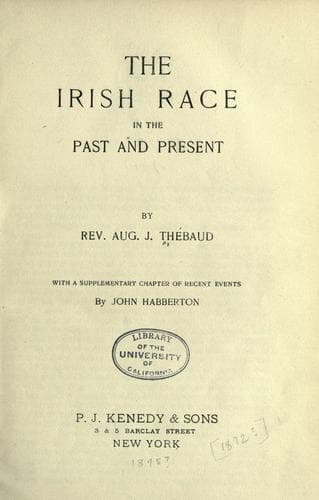
The Irish Race in the Past and the PresentThébaud, Augustus J.
History
The Irish Race in the Past and the Present
Thébaud, Augustus J.
Ireland -- History
Turning now to those prelates, monks, and priests, who during
Elizabeth's reign took part in Irish politics against the queen,
can we on that account deny them the title of martyrs to their
faith?
Dr. Hurley, Archbishop of Cashel, whose memoirs were published
by Miles O'Reilly, may be taken as a type of this class. Suppose,
as well grounded, although never proved, the suspicion of the
English Government with regard to his political mission.
Prelates and priests, generally speaking, were put to death
under Elizabeth, or confined to dungeons on mere suspicion, and,
as we have seen in the case of the Archbishop of Armagh, even
clear proofs of their innocence would not save them.
On his father's side, Dr. Hurley was naturally in the interest
of James Geraldine, Earl of Desmond; and, on his mother's, he
belonged to the royal family of O' Briens of Munster.
Consecrated Archbishop of Cashel at Rome in 1550, under Gregory
XIII., during the Geraldine rebellion, he was compelled to use
the utmost precaution in entering Ireland. The police of
Elizabeth was particularly active at that time in hunting up
priests and monks throughout the whole island, but particularly
in the south.
The archbishop escaped all these dangers, and he avoided the
certain denunciation of Walter Baal, the Mayor of Dublin
probably, who was then actually persecuting his mother, Dame
Eleanor Birmingham; he fled to the castle of Thomas Fleming, who
concealed him in a secret chamber in his house and treated him
as a friend. But when everybody thought the danger past, and
that it was no longer imprudent for him to mix in the society of
the castle, he was suspected by an Anglo-Irishman of the name of
Dillon, denounced by him, and finally surrendered by Thomas
Fleming, and conveyed to Dublin, where proceedings were set on
foot against him by the Irish Council and the queen's ministers
in England.
His imprisonment was coincident with the suppression of the
rising in Munster, and the Earl of Desmond was beginning that
frightful outlaw-life which only ended with his miserable death.
The object of the archbishop's accusers was to connect him with
the designs of Rome and the Munster insurrection; and the state
papers preserved in London have disclosed to us the
correspondence between Adam Loftus, the Protestant Archbishop of
Dublin, on the one side, and Walsingham and Cecil on the other.
Public-domain text, read in full here on John Shaqi.
Reviews
Reviews
No reviews yet
Be the first to share your thoughts on this work.
Elsewhere in the archive
Join the Discussion
Join the discussion
Sign in to leave a comment or review.
Sign InorCreate an account