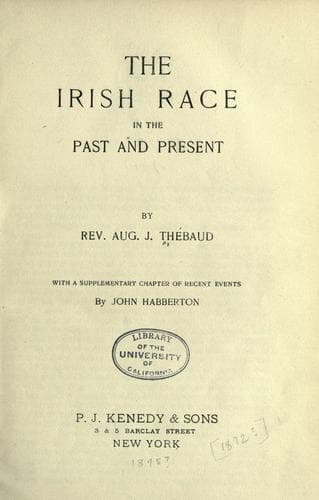
The Irish Race in the Past and the PresentThébaud, Augustus J.
History
The Irish Race in the Past and the Present
Thébaud, Augustus J.
Ireland -- History
The only proofs of the Archbishop's having joined the southern
confederacy were: 1. Suspicions, as he was consecrated in Rome
about the time of the sailing of the expedition under James
Fitzmaurice; 2. The information of a certain Christopher
Barnwell, then in jail, who was promised his life if he could
furnish proofs enough to convict the prelate. The value of the
testimony of an "informer" under such circumstances is
proverbial; yet all Barnwell could allege was, that "he was
present at a conversation in Rome between Dr. Hurley and
Cardinal Comensis, the Pope's secretary, and, the result of the
whole conversation was, "that the doctor did not know nor
believe that the Earl of Kildare had joined the rebellion of
Fitzmaurice and Desmond, and he was rebuked by the cardinal for
not believing it."
This was considered overwhelming proof against him, in spite of
his positive denial. Torture was applied, but the most awful
sufferings could not wring from him the acknowledgment of having
taken part in the conspiracy. Yet Loftus and Wallop were of
opinion that he was a "rebel" and ought to be put to death. The
only difficulty which presented itself to the "Lords Justices"
of Ireland was, that there was no statute in Ireland against
"traitors" who had plotted beyond the seas, and they asked that
the archbishop should either be sent to be tried in England, or
tried in Ireland by martial law, which would screen them from
responsibility.
This last favor was granted them; and the holy archbishop was
taken from prison at early dawn, on a Friday, either in May or
June, 1584. He was barbarously hanged in a withey (withe)
calling on God, and forgiving his torturers with all his heart.
Our purpose is not to inveigh against this judicial murder, and,
by further details, increase the horror which every honest man
must feel at the narrative of such atrocious proceedings. We
will suppose, on the contrary, that the cooperation of the
Archbishop of Cashel with Fitzmaurice and Desmond, and even with
the Pope and King of Spain, had been clearly proved--as it is
certain that, if not in this case, at least in some others,
during the reign of Elizabeth, the bishops or priests accused
had really taken part in the attempt of the Irish to free
themselves from such tyranny--and insist that, even then, the
murdered Catholic ecclesiastics really died for their religion,
and could be called "rebels" in no sense whatever.
Public-domain text, read in full here on John Shaqi.
Reviews
Reviews
No reviews yet
Be the first to share your thoughts on this work.
Elsewhere in the archive
Join the Discussion
Join the discussion
Sign in to leave a comment or review.
Sign InorCreate an account