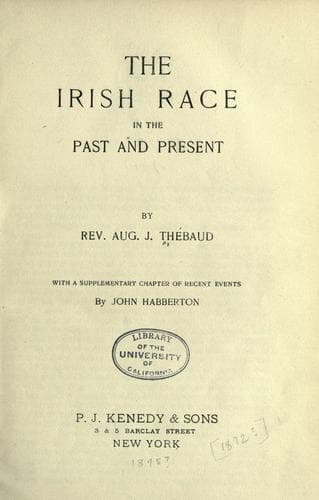
The Irish Race in the Past and the PresentThébaud, Augustus J.
History
The Irish Race in the Past and the Present
Thébaud, Augustus J.
Ireland -- History
The English upper classes, as a whole, were utterly indifferent
to religion; the one thing which affected them, soul and body,
was their temporal interests, and, to judge by their ready
acquiescence in all the changes set forth at the commencement of
the last chapter, they would as soon have turned Mussulmen as
Calvinists. The lower classes, at first merely passive, became
afterward possessed by a genuine fanaticism for the new creed
established by the Thirty-nine Articles; so that, from that
period until quite recently--and the spirit still lives--an
English mob was always ready to demolish Catholic chapels, and
establishments of any kind, wherever the piety of a few had
succeeded in erecting such, however quietly.
It is evident from the facts mentioned that, prior even to that
extraordinary religious revolution called the Reformation, the
Catholic faith did not possess a firm hold upon the English mind
and heart, whatever may have been the case in previous ages. It
is clear that even "the people" in England were not ready to
submit to any sacrifice for the sake of their religion.
There is small doubt that Elizabeth foresaw this, and expected
but little opposition on the part of the English nobility and
people to the changes she purposed effecting. Had she imagined
that the nation would have been ready to submit to any sacrifice
rather than surrender their religion, she would at least have
been more cautious in the promulgation of her measures, even
though she had determined to sever her kingdom from Rome. She
might have rested content with the schism introduced by her
father, and this indeed would have sufficed for the carrying out
of her political schemes.
But she knew her countrymen too well to accredit them with a
religious devotion which, if they ever possessed, had long ago
died out. She saw that England was ripe for heresy, and the
result confirmed her worldly sagacity. How came it, then, that
the change which was absolutely impossible in Ireland, was so
easily effected in the other country? Or, to generalize the
question: How is it that, to speak generally, the nations of
Northern Europe embraced Protestantism so readily, while those
of Southern Europe refused to receive it, or were only slightly
affected by it? Ranke has remarked that, when, after the first
outbreak in the North, the movement had reached a certain point
in time and space, it stopped, and, instead of advancing further,
appeared to recede, or at least stood still.
Public-domain text, read in full here on John Shaqi.
Reviews
Reviews
No reviews yet
Be the first to share your thoughts on this work.
Elsewhere in the archive
Join the Discussion
Join the discussion
Sign in to leave a comment or review.
Sign InorCreate an account