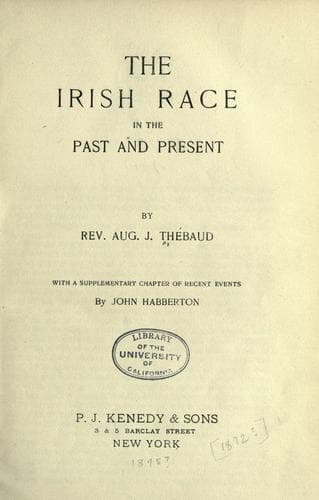
The Irish Race in the Past and the PresentThébaud, Augustus J.
History
The Irish Race in the Past and the Present
Thébaud, Augustus J.
Ireland -- History
Many Protestant writers have attempted a weak and flippant
solution of the question, and we are continually told of the
superior enlightenment of the northern races, of their
attachment to liberty, of their higher civilization, and other
very fine and very easily-quoted things of the same kind, which,
at the present moment, are admitted as truths by many, and
esteemed as unanswerable explanations of the phenomenon.
According to this opinion, therefore, the southern races were
more ignorant, less civilized, more readily duped by priestcraft
and kingcraft; above all, readier to bow to despotism, and
indifferent to freedom.
Catholic writers, Balmez principally, have often given a
satisfactory answer to the question; yet, the replies which they
have made to the various sophisms touched upon, have seemingly
produced no effect on the modern masses, who continue steadfast
in their belief of what has been so often refuted. It would be
presumptuous and probably quite useless, on our part, to enter
into a lengthened discussion of the question. But, when confined
to England, it is a kind of test to be applied to all those
subjects of civilization and liberty, and is so clear and true
that it cannot leave the least room for doubt or hesitation:
moreover, as it necessarily enters into the inquiry which forms
the heading of this chapter, it cannot be entirely laid aside.
All that we purpose doing is, discovering why the northern
nations fell a prey more readily to the disorganizing doctrines
of Protestantism than the southern. The general fickleness of
the human mind, which is so well brought out by the great
Spanish writer, does not strike us as a sufficient cause; for
the mind of southern peoples is certainly not less fickle, on
many points at least, than that of other races.
In our comparison between the North and the South, we class the
Irish with the latter, although, geographically, they belong to
the former, and, indeed, constitute the only northern nation
which remained faithful to the Church.
First, let us state the broad facts for which we wish to assign
some satisfactory reasons.
After the social convulsions which attended the change of
religion had subsided somewhat, it was found that Protestantism
had invaded the three Scandinavian kingdoms, to the almost total
exclusion of Catholicism, to such an extent, indeed, that, until
quite recently, it was death or transportation for any person
therein to return to the bosom of the mother Church.
The same statement is true, to almost the same extent, of
Northern Germany, where open persecution, or rather war, raged
until the establishment of "religious peace" toward 1608. Saxony,
whence the heresy sprang, was its centre and stronghold in
Germany; and the Saxons were Scandinavians, having crossed over
from the southern-borders of the Baltic, where, for a long time,
they dwelt in constant intercourse with the Danes, Norwegians,
and Swedes.
Public-domain text, read in full here on John Shaqi.
Reviews
Reviews
No reviews yet
Be the first to share your thoughts on this work.
Elsewhere in the archive
Join the Discussion
Join the discussion
Sign in to leave a comment or review.
Sign InorCreate an account