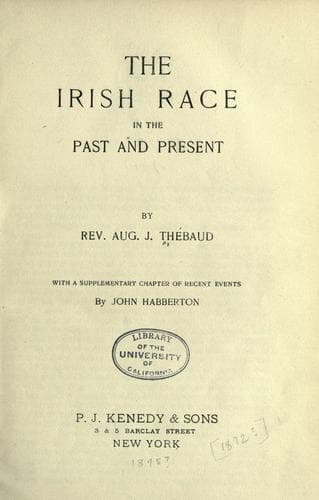
The Irish Race in the Past and the PresentThébaud, Augustus J.
History
The Irish Race in the Past and the Present
Thébaud, Augustus J.
Ireland -- History
Saxon and Norman England was found to be, at the end of the
sixteenth century, almost entirely Protestant, and the
persecution of the comparatively few Catholics who survived
flourished therein full vigor.
A singular phenomenon presented itself in the Low Countries.
That portion of them subsequently known as Holland, which was
first invaded and peopled by the Northmen of Walcheren, became
almost entirely Protestant, while Belgium, which was originally
Celtic, remained Catholic.
Bavaria, Austria, and Switzerland, were divided between
Protestantism and Catholicity, and the division exists to this
day.
In France a section only of the nobility, which was originally
Norman as well as Frank, and under feudalism had become
thoroughly permeated by the northern spirit, was found to have
embraced the new doctrines, which were repudiated by the people
of Celtic origin. It is true that, later on, the Cevennes
mountaineers received Protestantism from the old Waldenses; but
we are presenting a broad sketch, and do not deny that several
minor lineaments may not fall in with the general picture.
In Italy only literary men, in Spain a few rigorist prelates and
monks, showed any inclination toward the "reform" party.
On the whole, then, it is safe to conclude that the Scandinavian
mind was congenial to Protestantism.
We say the Scandinavian mind, because the Scandinavian race
extended, not only through Scandinavia proper, but also through
Northern Germany, along the Baltic Sea and German Ocean; through
Holland by Walcheren; through a portion of Central and Southern
Germany, as far down as Switzerland, which was invaded by Saxons
at the time of Charlemagne, and after him, until Otto the Great
gave them their final check, and subdued them more thoroughly
than the great Charles had succeeded in doing.
Common opinion traces the Scandinavians and Germans back to the
same race. In the generic sense, this is true; and all the Indo-
Germanic nations may have originally belonged to the same parent
stock; but, specifically, differences of so striking a nature
present themselves in that immense branch of the human family,
that the existence of sub-races of a definite character,
presupposing different and sometimes opposite tendencies, must
be admitted.
Who can imagine that the Germans proper are identical with the
Hindoos, although by language they, in common with the greater
part of European nations, may belong to the same parent stock?
In like manner, the Germanic tribes, although possessing many
things in common with the Scandinavian race, differ from it in
various respects.
Public-domain text, read in full here on John Shaqi.
Reviews
Reviews
No reviews yet
Be the first to share your thoughts on this work.
Elsewhere in the archive
Join the Discussion
Join the discussion
Sign in to leave a comment or review.
Sign InorCreate an account