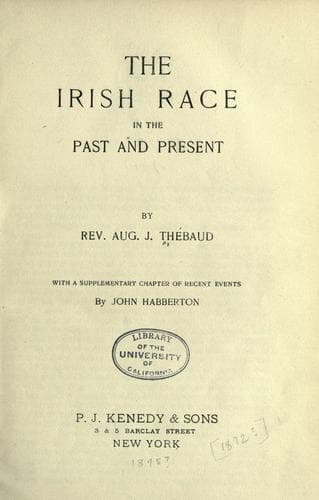
The Irish Race in the Past and the PresentThébaud, Augustus J.
History
The Irish Race in the Past and the Present
Thébaud, Augustus J.
Ireland -- History
The best ethnographic writers admit that the Scandinavian race,
which they, in our opinion improperly, name Gothic, differed
greatly in its language from the Teutonic. The language of the
first, retained in its purity in Iceland to this day, soon
became mixed up with German proper in Denmark, Sweden, and even
in Norway to a great extent. The languages differed therefore
originally, as did, consequently, the races. Even at this very
moment an effort is being made by Scandinavians to establish the
difference between themselves and the Teutons with respect to
language and nationality.
How far the religion of both was identical is a difficult
question. We believe it very probable that the worship of Thor,
Odin, and Frigga, was purely Scandinavian, and penetrated
Germany, as far as Switzerland, with the Saxons. Hertha,
according to Tacitus, was the supreme goddess of the Germans.
She had no place in Scandinavian mythology. Ipsambul, so
renowned among the Teutons, was quite unknown in Scandinavia.
The Germans, in common with the Celts, considered the building
of temples unworthy the Deity; whereas, the Scandinavian temples,
chiefly the monstrous one of Upsala, are well known. Many other
such facts might be brought out to show the difference of their
religions.
The Germans showed themselves from the beginning attached to a
country life; and we know how the Frankish Merovingian kings
loved to dwell in the country. The Scandinavians only cared for
the sea, and manifested by their skill in navigation how they
differed from the Germans, who were less inclined even than the
Celts for large naval expeditions.
All this is merely given as strong conjecture, not as proof
positive amounting to demonstration, of the real difference
between the two races--the Germanic and Scandinavian.
But how was Protestantism congenial to the Scandinavian mind?
This second question is of still greater importance than the
first.
In the earlier portion of the book, we passed in review the
character of the tribes, once clustered around the Baltic, with
the exception of the Finns, who dwelt along the eastern coast;
and, grounding our opinion on unquestionable authorities, we
found that character to consist mainly of cruelty, boldness,
rapacity, system, and a spirit of enterprise in trade and
navigation.
When they embraced Christianity, it undoubtedly modified their
character to a great extent, and many holy people lived among
them, some of whom the Church has numbered among the saints. But
the conquest of these ferocious pirates was undoubtedly the
greatest triumph ever achieved by the holy Spouse of Christ.
Public-domain text, read in full here on John Shaqi.
Reviews
Reviews
No reviews yet
Be the first to share your thoughts on this work.
Elsewhere in the archive
Join the Discussion
Join the discussion
Sign in to leave a comment or review.
Sign InorCreate an account